 Why Sticking with Legacy BI Tools Costs More Than You Think
In today’s data-driven world, BI tools are the linchpin for timely, insight-driven decision-making. Yet, many enterprises are stuck using outdated BI tools that are expensive to maintain, slow to deliver insights, and unable to support modern analytics initiatives. The fear of high migration costs or business disruption often keeps organizations on these legacy systems far longer than is beneficial.
If your organization is feeling the strain of aging BI tools, the good news is that modernization does not have to be an expensive, drawn-out ordeal. With a structured, phased approach and proven accelerators like those offered by KPI Partners, you can modernize your BI tools faster, cheaper, and with less risk, transforming your reporting ecosystem while staying on budget.
In this guide, we’ll explore:
- Why sticking with legacy BI tools costs more than you think
- The hidden risks of outdated BI tools
- Cost-effective modernization strategies
- KPI Partners’ proven methodology for Power BI tool migration
- Practical steps you can take to modernize without breaking the bank

Why Sticking with Legacy BI Tools Costs More Than You Think
Many enterprises continue to operate outdated BI tools because they fear the perceived high cost of modernization. However, legacy BI tools come with significant hidden costs that drain your IT budget and limit business agility:
1- High Licensing and Maintenance Fees:
Older BI tools often have steep annual renewal costs that increase over time, even as the technology becomes less effective.
2- Manual Reporting Processes:
Aging BI tools often require extensive manual data manipulation, pulling IT and analyst resources away from value-added work.
3- Delayed Insights:
Slow report refresh rates and poor user experience result in decision-making lags that impact competitiveness.
4- Low Adoption:
Users resist using outdated BI tools due to clunky interfaces and unreliable data, leading to shadow IT and fragmented reporting practices.
5- Compliance Risks:
Legacy BI tools may lack the governance and security capabilities needed to meet evolving regulatory requirements.
The longer your organization delays modernization, the more these hidden costs compound, consuming budgets that could instead drive growth and innovation.

The Hidden Risks of Outdated BI Tools
Beyond cost, legacy BI tools introduce significant operational and strategic risks:
Data Inconsistencies:
Disparate reports and metrics lead to conflicting versions of the truth, causing decision paralysis across teams.
Limited Scalability:
Legacy architectures cannot easily handle increased data volumes, slowing insights as your business grows.
Security Vulnerabilities:
Older BI tools may not align with modern security frameworks, leaving your organization exposed to compliance violations and breaches.
Inability to Support Advanced Analytics:
Modern analytics initiatives, including AI and predictive modeling, require agile, cloud-based environments that outdated BI tools cannot provide.
These risks collectively prevent your business from harnessing the full value of your data, reducing your competitive advantage in a rapidly evolving market.
Cost-Effective Strategies for BI Tool Modernization
Modernizing your BI tools does not have to be prohibitively expensive or risky. By following a structured, phased approach, you can modernize effectively while controlling costs:
- Conduct a Readiness Assessment: Evaluate your current BI tools and reporting environment to identify inefficiencies, redundancies, and high-impact modernization opportunities. Download a readiness checklist.
- Prioritize Quick Wins: Identify reports and processes that will deliver immediate ROI when modernized, allowing you to demonstrate value early.
- Use Automated Migration Utilities: Offerings like the BI Modernization Accelerator within the KPI DataBridge Suite reduce manual migration work, saving time and lowering the risk of errors.
- Adopt a Phased Migration Approach: Rather than a disruptive “big bang” migration, leverage pilot programs and incremental migrations to minimize business disruptions.
- Leverage Prebuilt Frameworks: Using prebuilt templates and proven methodologies helps standardize reporting, accelerate timelines, and reduce consulting hours.
- Train Users Concurrently: Parallel user training ensures rapid adoption, maximizing your investment in new BI tools.
How KPI Partners Executes Cost-Effective Power BI Tool Modernization
KPI Partners offers a systematic, proven methodology for Power BI tool modernization that prioritizes cost efficiency, speed, and risk reduction. Here’s how:
Approaches to Migration
|
Incremental MigrationKPI Partners supports pilot or phased migrations to reduce disruption while maintaining business continuity. |
Consolidation Before MigrationCombining redundant reports and datasets before moving to a modernized BI tool eliminates inefficiencies and reduces migration workload. |
|
Lift and ShiftFor clients requiring a direct 1:1 migration, KPI offers rapid migrations while preserving report fidelity. |
Post-Migration OptimizationBeyond migration, KPI Partners helps optimize dashboards and analytics for best-practice adoption in modern BI tools such as Power BI. |




Step-by-Step Execution Approach
1- Assessment and Extract
- Review report lineage and architecture within legacy BI tools (e.g., Qlik, Business Objects, OBIEE).
- Identify overlaps and redundancies to streamline the migration process.
- Map dependencies and prepare data systematically for extraction.
2- Migration Execution
- Migrate data sources and models into the modern BI tool (e.g., Power BI) efficiently.
- Transition visualizations while maintaining original fidelity.
- Using GenAI-assisted automation, convert calculations from the old data model into the new data model that allows users to define measures, calculated columns, and calculated tables to extract meaningful insights from data.
- Apply client branding and templates for consistent, professional reporting.
3- Validation
- Perform automated, systematic data validation to ensure accuracy.
- Execute automated visual validation to confirm layout and functionality.
- Use the KPI DataBridge Suite and its BI Modernization Accelerator utilities to compare outputs between legacy BI tools and the modern BI tool.
KPI Partners structures engagements to minimize risk and cost while aligning with your readiness.
A Typical Roadmap for BI Modernization with KPI Partners:
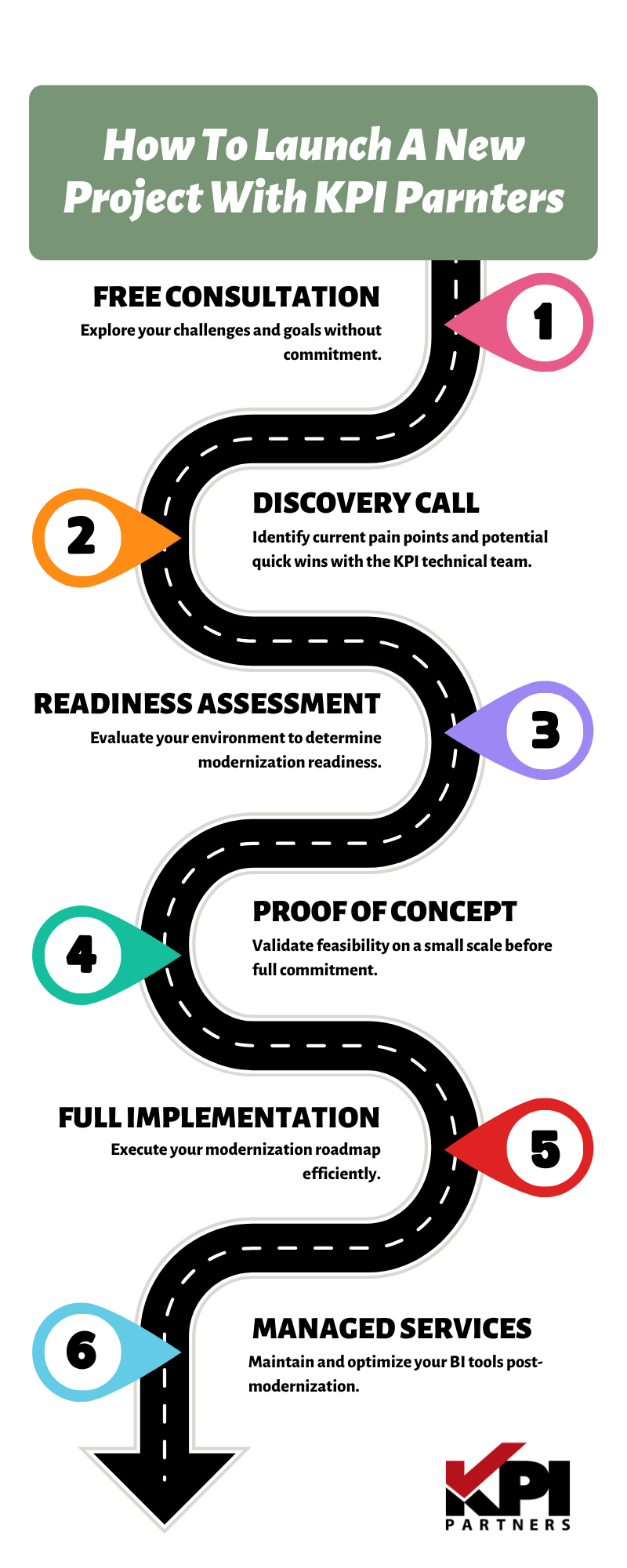
- Free Consultation: Explore your challenges and goals without commitment. Schedule a consultation here.
- Discovery Call: Identify current pain points and potential quick wins with the KPI technical team.
- Readiness Assessment: Evaluate your environment to determine modernization readiness.
- Proof of Concept: Validate feasibility on a small scale before full commitment.
- Full Project Implementation: Execute your modernization roadmap efficiently.
- Managed Services: Maintain and optimize your BI tools post-modernization with the Analytics & Insight Accelerator and the Productivity & GenAI Accelerator.
Real-World Impact: A BI Modernization Case Study
A Fortune 500 enterprise migrated from Qlik to Power BI using KPI Partners’ structured approach, reducing its reporting cycles from weeks to hours and cutting infrastructure costs by 40%. With automated migration utilities, the organization was able to modernize over 3,000 reports with minimal disruption while ensuring data accuracy and report consistency. User adoption climbed by 50% post-modernization, enabling self-service analytics at scale and empowering the enterprise to focus on advanced analytics initiatives like predictive modeling and AI.
This success showcases how BI tool modernization can deliver measurable, impactful results without straining your budget.
Practical Steps You Can Take Today
If you’re ready to explore BI tool modernization without breaking the bank, here’s what you can do now:
- Assess Your Current BI Environment: Identify key pain points, high-cost areas, and inefficiencies.
- Calculate Your Total Cost of Ownership (TCO): Understand the hidden costs of staying on legacy BI tools.
- Engage for a Free Consultation: Partner with KPI Partners to discuss modernization strategies aligned with your goals.
- Plan for a Pilot: Begin with a low-risk proof of concept to demonstrate feasibility and ROI.
- Build Momentum: Use quick wins to build support for a broader modernization initiative.
Conclusion: Modernizing BI Tools Without Breaking the Bank
Modernizing your BI tools is not just a technical upgrade—it is a strategic investment in your organization’s agility, efficiency, and future competitiveness. With the right partner, structured process, and proven accelerators, your business can transition from outdated, costly BI tools to a modern, scalable analytics environment efficiently and affordably.
The cost of inaction is far greater than the investment in modernization. Don’t let legacy BI tools hold your business back.
Ready to Take the Next Step?
Schedule a Free Consultation with KPI Partners to explore how you can modernize your BI tools quickly and cost-effectively.