How Machine Learning on AWS Enables Predictive Retail at Scale
Retailers today process massive volumes of data, yet only a fraction of organizations can act on it in real time, limiting their ability to respond to demand shifts and customer behavior. Studies show that organizations leveraging advanced analytics and AI can significantly improve forecasting accuracy and customer engagement, but many retailers still rely on traditional analytics systems.
Machine learning is transforming this landscape by enabling predictive retail at scale. By combining AWS services such as Amazon SageMaker and Amazon Bedrock with KPI Partners’ expertise in data engineering and AI, retailers can build scalable solutions for demand forecasting, personalization, and operational intelligence. This joint approach enables organizations to move from reactive analytics to real-time, data-driven decision-making.
This blog explores how predictive retail works in practice and how KPI Partners helps organizations implement these capabilities at scale.
What Challenges Can Predictive ML Solve?
1. Improving Demand Forecasting
Machine learning models analyze historical sales, promotions, seasonality, and external factors to predict demand more accurately. This helps retailers plan procurement and ensure product availability.
2. Inventory Optimization
Predictive models optimize inventory across warehouses and stores by dynamically adjusting stock levels based on demand and supply conditions, reducing excess inventory and stockouts.
3. Supply Chain Optimization
Machine learning analyzes logistics and supplier data to identify inefficiencies and potential disruptions. Retailers can reroute shipments and optimize fulfilment to maintain delivery performance.
4. Workforce and Store Planning
Predictive analytics forecast store traffic and workloads, enabling better staff scheduling and improved operational efficiency during peak and low-demand periods.
Enterprise Machine Learning Use Cases in Retail
1. Enable Real-Time Customer Intelligence
Use Case: Retailers unify data from e-commerce platforms, loyalty programs, mobile apps, and marketing systems to create a centralized customer data layer. Machine learning models analyze clickstream data, purchase history, and engagement patterns to generate real-time insights such as product affinity, churn risk, and next-best actions. These insights are integrated into customer-facing applications to power personalization across digital and in-store channels.
Outcome:
More relevant personalization, improved customer engagement, increased conversion rates, and higher customer lifetime value.
2. Optimize Demand Forecasting
Use Case: Machine learning models leverage historical sales data, promotional calendars, seasonality, and external variables such as weather and market trends to predict demand at SKU, store, and regional levels. Advanced forecasting models continuously learn from new data, enabling more accurate and dynamic demand planning across large product catalogs and distributed retail networks.
Outcome:
Improved forecast accuracy, reduced stockouts, optimized inventory levels, and more efficient procurement and replenishment planning.
3. Improve Supply Chain Visibility
Use Case: Machine learning models analyze logistics data, supplier performance, inventory flows, and operational KPIs to identify inefficiencies and predict potential disruptions. These models enable real-time monitoring of supply chain operations and support optimization of routing, inventory allocation, and fulfillment strategies across distribution networks.
Outcome:
Increased supply chain efficiency, faster and more informed decision-making, reduced operational costs, and improved service levels.
How to Build Scalable ML Architectures on AWS
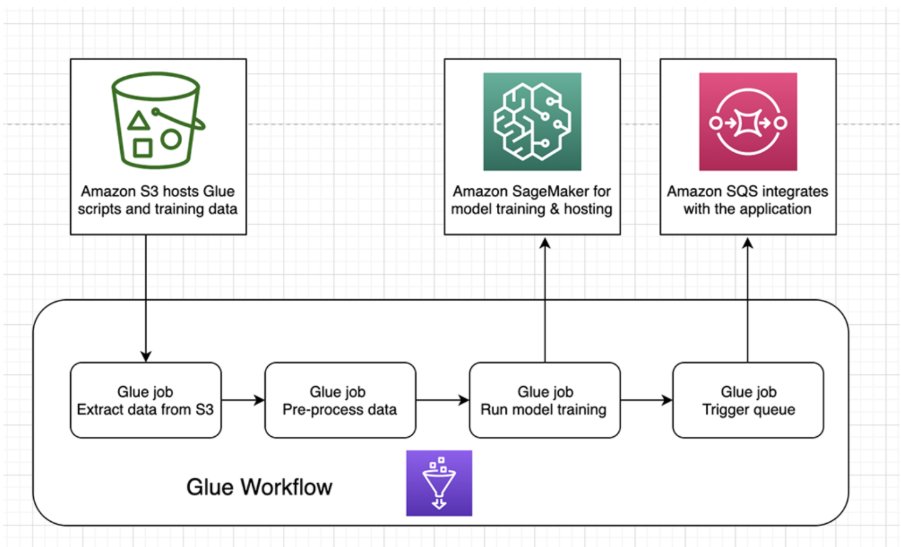
Retailers need more than models to operationalize predictive retail. They require scalable architectures that support data pipelines, model deployment, and real-time inference. AWS provides a set of services that enable this at scale.
1. Centralize Data
Ingest data from e-commerce, POS, and supply chain systems into a data lake using Amazon S3 to create a unified data foundation.
2. Prepare and Engineer Features
Use AWS Glue and Amazon Athena to clean and transform data, ensuring consistent inputs for machine learning models. Building and managing these pipelines at scale requires strong foundations in data engineering.
3. Train and Deploy Models
Leverage Amazon SageMaker to build, train, and deploy machine learning models that power recommendations, forecasting, and operational insights.
4. Enable Continuous Learning
Implement MLOps pipelines to monitor performance and retrain models as new data becomes available, ensuring models remain accurate over time.
Accelerating Predictive Retail on AWS with KPI Partners
Adopting predictive retail on AWS requires careful architecture planning, including aligning data platforms, pipelines, and governance for scalable AI workloads.
KPI Partners is a select tier partner of AWS. We help retailers design and implement scalable ML architectures on AWS, backed by real-world implementations and KPI Partners AWS cloud analytics solutions including Amazon S3 for data lakes, AWS Glue and Athena for data processing, Amazon SageMaker for model development and deployment, and Amazon Bedrock for generative AI applications.
Combining machine learning with generative AI (GenAI), retailers can move beyond predictions to action using Bedrock to enable conversational insights, automate decision-making, and deliver AI-driven customer experiences.