
Executive Summary
Data-driven decision-making is no longer optional, but many BI initiatives fail to deliver due to hidden data challenges. This paper reveals why investing in your data foundation is essential to transform BI tools from flashy dashboards into engines of real business value.
In today’s data-driven world, enterprises invest heavily in Business Intelligence (BI) platforms like Power BI, Tableau, Qlik, and others, expecting faster insights and better decisions. Yet too often, these tools fail to deliver the promised value—not because of the tools themselves, but because
“business intelligence is only as good as the data beneath it.”
BI teams and business users face frustrating delays and distrust when reports don’t match operational data, dashboards load inconsistently, or critical insights are built on stale or incomplete data. This disconnect leads to low user adoption, wasted BI investments, and missed opportunities for growth.
At the heart of this challenge lies the hidden dependency: the need for a robust, modern, and governed data foundation to power analytics. BI tools depend on reliable data lakes and warehouses, consistent ETL pipelines, accurate semantic models, and strong governance practices to deliver meaningful insights at scale. Without these components, even the best dashboards become a source of confusion rather than clarity.
Enterprises need a structured, accelerated approach to modernize their data platforms and BI ecosystems simultaneously. The KPI DataBridge Suite fills this critical need with its portfolio of enterprise-ready accelerators.
With the DataBridge Suite, organizations can break down silos, restore trust in their BI platforms, and enable data-driven decision-making across the enterprise. By building a solid data foundation, enterprises can fully realize the promise of their BI investments—delivering faster insights, better decisions, and competitive advantage.
This white paper explores the dependency between BI and data readiness, the hidden costs of ignoring this dependency, and the structured path enterprises can follow to modernize their data and analytics environment for maximum business impact.
Table of Contents
- The Promise and Frustration of Business Intelligence
- The Hidden Dependencies: Why BI Tools Depend on Data Foundations
- The Anatomy of a Data Foundation That Supports BI
- The Cost of Ignoring the Data Foundation
- How the KPI DataBridge Suite Solves This Challenge
- Case Study: Building a Modern Data Foundation to Power Enterprise Analytics
- Your Next Steps: Preparing for a Successful BI Modernization
- Conclusion: Modern BI Success Starts with a Modern Data Foundation

The Promise and Frustration of Business Intelligence
Business leaders invest in BI expecting clarity, speed, and actionable insights, yet many are left with underused dashboards, inconsistent metrics, and stakeholder frustration. This section explores why expectations often fail to match reality, eroding trust and ROI in BI investments.
For years, Business Intelligence (BI) tools have been marketed as the key to unlocking faster, data-driven decisions across the enterprise. Platforms like Power BI, Tableau, and others promise intuitive, self-service analytics, eliminating the dependency on IT teams for every report while empowering users to explore, visualize, and share insights with ease.
The promise is clear: with BI, business leaders and analysts can gain a real-time understanding of their operations, customer behavior, and market trends, enabling smarter decisions that drive competitive advantage. Organizations envision dashboards lighting up conference rooms, sales managers tracking pipelines effortlessly, finance teams forecasting with precision, and operations leaders pinpointing inefficiencies instantly.
And to some extent, BI tools deliver on these promises—when the conditions are right.
However, many enterprises quickly find themselves grappling with a frustrating reality: despite significant investments in BI tools, the expected value often remains out of reach. Adoption rates plateau. Users express dissatisfaction with data accuracy. Reports become sources of confusion rather than clarity, and the gap between “data available” and “insights delivered” widens.
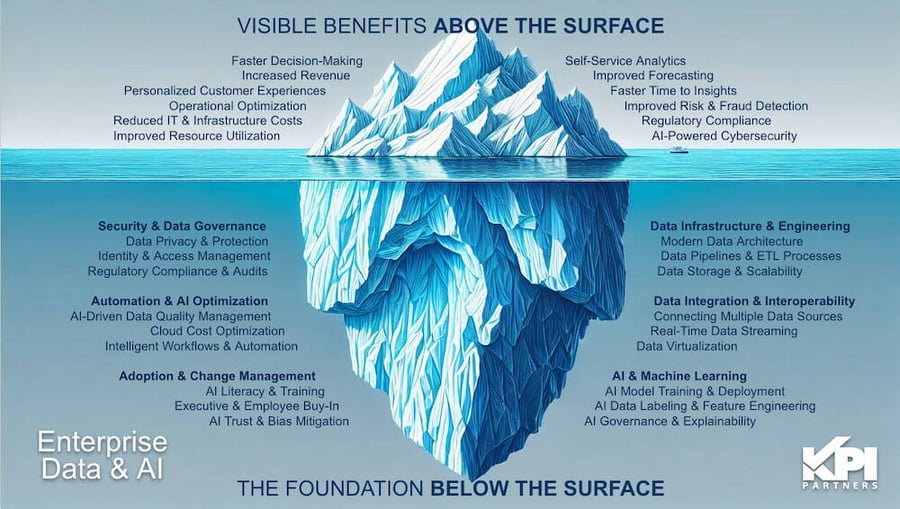
Like the Titanic, which was sunk by the unseen mass beneath the water, many BI initiatives are jeopardized by hidden challenges below the surface—data quality, governance, integration, and architecture—that can tear through even the most promising BI strategies.
Pain Points Experienced by BI Teams and Users
The frustrations typically surface as:
- Data Discrepancies: “Why doesn’t this report match our operational data?” Users often see differences between BI reports and transactional systems, leading to distrust and abandonment of dashboards.
- Inconsistent Metrics: Different departments create similar reports with different calculations, leading to conflicting numbers and debates over which version of the data is correct.
- Data Latency: Reports load slowly, or refresh cycles are too infrequent, resulting in outdated data driving critical decisions.
- Shadow IT Proliferation: When users don’t trust or get what they need from official BI channels, they resort to manual workarounds—building their own reports in Excel or extracting raw data for analysis. This creates silos and governance challenges.
- Low Adoption Rates: Despite sophisticated dashboards, user adoption remains low because stakeholders don’t trust the data or find the reports hard to interpret.
- IT Bottlenecks: The promise of self-service analytics often falls short when foundational data issues force BI teams to rely heavily on IT for data extraction, transformation, and pipeline maintenance.
- Lack of Alignment with Business Needs: Dashboards may look impressive, but fail to answer critical business questions, leading to low perceived value among executives and managers.
Why Does This Happen?
At the heart of these frustrations is a misalignment between the promise of BI tools and the reality of enterprise data readiness. BI tools can only transform and visualize the data they are given. If that data is inconsistent, incomplete, stale, or not aligned with business context, the insights produced by even the most advanced BI platforms will be unreliable.
Many organizations attempt to modernize their BI platforms without first addressing underlying issues in their data infrastructure. Legacy data platforms, fragmented ETL pipelines, poor data quality, and a lack of governance frameworks undermine the effectiveness of BI initiatives. BI teams are often placed in the impossible position of being held accountable for delivering actionable insights while having little control over the upstream data quality, structure, and availability.
“Dashboards can only reveal what your data allows.”
This dependency is often overlooked in the rush to modernize analytics. Leaders expect dashboards to deliver results without acknowledging the critical foundation required to support them. BI teams, in turn, become reactive, spending excessive time troubleshooting data discrepancies instead of building high-value, insightful reporting assets.
The Cost of Frustration
The result of this disconnect is tangible:
- Delayed decision-making due to low trust in insights.
- Wasted time spent reconciling conflicting reports.
- Poor ROI on BI investments.
- Slower business operations due to manual reporting workarounds.
- Missed opportunities for agility in responding to market changes.
Setting the Stage for Change
The promise of Business Intelligence is still within reach—but it requires recognizing and addressing the dependency BI has on a strong, modern, and governed data foundation. Enterprises that wish to unlock the full value of their BI investments must first modernize their data platforms, ensure data quality and governance, and align their data architecture to their business context.
Only then can BI truly deliver on its promise, transforming data into trusted insights that drive better decisions at every level of the organization.

The Hidden Dependencies: Why BI Tools Depend on Data Foundations
The reason many BI initiatives underperform isn’t the tools themselves but the hidden dependency on reliable, governed data. Without a strong foundation, dashboards will reflect data inconsistencies, delays, and errors, undermining their intended impact.
The effectiveness of Business Intelligence tools is fundamentally tied to the quality and availability of the data they consume. While many organizations focus on the front-end visualization and dashboard capabilities of tools like Power BI, Oracle BI, Tableau, Qlik, and others, the reality is that BI tools are only as strong as the data foundation that supports them. This dependency often remains hidden until issues of trust, adoption, and accuracy surface, stalling or derailing BI initiatives entirely.
Most BI strategies focus on what’s visible above the surface—dashboards, reports, and analytics. Yet, like an iceberg, the true enablers of BI lie beneath: data pipelines, governance, and quality. Failing to address these foundational elements is what ultimately sinks BI initiatives.
The Layers Beneath BI
Modern BI platforms rely on several foundational layers to deliver accurate, timely, and actionable insights:
Data Lakes and Data Warehouses
These are the backbone of scalable data availability. A data lake allows for the storage of vast amounts of structured and unstructured data at a relatively low cost, while a data warehouse organizes this data into a structured format optimized for analysis.
If these platforms are outdated, poorly governed, or fragmented across business units, BI tools cannot effectively access the unified, clean, and relevant data needed for insightful reporting. Data duplication and inconsistency across silos further exacerbate the problem, leading to a “garbage in, garbage out” scenario.
ETL Pipelines and Data Conversion
Extract, Transform, Load (ETL) processes convert raw data into a usable state for BI consumption. They cleanse, standardize, and enrich data from multiple sources, ensuring consistency across reports.
When ETL pipelines are fragile, manual, or inconsistent, BI teams receive incomplete or inaccurate datasets, creating discrepancies in dashboards and delaying reporting cycles. Without robust ETL processes, critical data might not arrive at the BI layer on time, rendering real-time or near-real-time analytics impossible.
Data Modeling
Data models define the structure and relationships within datasets, making data intelligible to business users and analytics tools. Semantic models, key for BI platforms, allow users to slice and dice data in ways that align with business processes and terminology.
Without proper data modeling, end-users face difficulties in interpreting reports, and inconsistencies emerge when different teams define metrics differently. This not only slows down analysis but also creates confusion about which numbers are accurate, undermining trust in the BI platform.
Data Quality Controls
Data accuracy, completeness, and consistency are non-negotiable for meaningful analytics. Data quality controls—including validation, cleansing, and monitoring—ensure that erroneous or duplicate records do not distort reporting.
When data quality is poor, even the most visually appealing dashboards lose credibility. Business decisions made on inaccurate insights can have significant financial repercussions, and stakeholders lose faith in the organization’s data-driven initiatives.
Data Governance
Data governance frameworks establish clear ownership, lineage, and security policies for data across the enterprise. This ensures compliance with regulatory standards and creates trust in data usage across teams.
Without governance, organizations face challenges in maintaining data integrity, controlling access, and ensuring that data is used responsibly. A lack of governance also makes it difficult to manage metadata, which is critical for understanding and maintaining data assets over time.
The Impact of Ignoring the Dependencies
Organizations that overlook these dependencies often find themselves facing:
- Frequent discrepancies between reports and operational systems.
- Delays in producing and updating dashboards due to poor data pipelines.
- High levels of manual intervention and troubleshooting by BI teams.
- Low user adoption due to a lack of trust in data accuracy.
- Fragmented views of the business due to inconsistent metrics across departments.
Ultimately, these issues diminish the value of BI investments and hinder the organization’s ability to leverage data for strategic advantage.
Building a Reliable Data Foundation for BI Success
To fully realize the promise of Business Intelligence, enterprises must prioritize the development of a robust data foundation. This includes:
- Migrating legacy systems to modern data platforms that scale and perform.
- Building automated, reliable ETL pipelines for consistent data delivery.
- Developing semantic data models aligned with business processes.
- Implementing data quality monitoring and proactive remediation strategies.
Establishing governance policies that align data use with compliance and business needs.
These components work together to ensure that when data reaches BI tools, it is accurate, timely, and aligned with how the business thinks and operates.
The Role of KPI Partners and the DataBridge Suite
KPI Partners understands these hidden dependencies and has designed the KPI DataBridge Suite to address them systematically. By leveraging accelerators like the Data Platform Migration Accelerator and BI Modernization Accelerator, organizations can modernize their data ecosystems while aligning their BI platforms for maximum impact.
The DataBridge Suite operationalizes best practices for data readiness, ensuring BI tools have the foundation they need to deliver on their promise of faster insights, better decisions, and an enterprise-wide data-driven culture.


The Anatomy of a Data Foundation That Supports BI
A modern data foundation is not a nice-to-have but a strategic enabler of analytics success. This section outlines the core pillars—platform modernization, data pipelines, governance, semantic modeling, and quality controls—that together power scalable, trusted insights.
The success of Business Intelligence (BI) platforms within an enterprise is not determined solely by the features of the BI tool itself, but by the strength and design of the underlying data foundation. A well-architected data foundation provides consistent, accurate, and timely data, empowering BI teams to deliver actionable insights that drive decision-making across all levels of the organization.
Below, we explore the critical components that together form a data foundation capable of supporting scalable, trustworthy, and effective BI initiatives.
Data Platform Modernization
At the core of a strong data foundation is the modernization of legacy data platforms. Many organizations still rely on outdated, on-premise databases and ETL tools that are costly to maintain, inflexible, and unable to scale with increasing data volumes and user demands.
Modern cloud-based platforms such as Microsoft Fabric, Databricks, and Snowflake offer scalable, high-performance environments designed to support enterprise analytics needs.
Migrating to these platforms allows organizations to:
- Store large volumes of structured and unstructured data cost-effectively.
- Enable elastic scaling based on workloads.
- Support advanced analytics, machine learning, and real-time data processing.
- Reduce infrastructure maintenance overhead.
A modern data platform is the first pillar in preparing an organization to feed reliable, timely data to BI platforms.
Data Ingestion and ETL Processes
Reliable Extract, Transform, Load (ETL) processes are essential for feeding data into your modern platform in a consistent, timely, and accurate manner. A robust ETL pipeline:
- Ingests data from multiple systems (CRM, ERP, operational databases, IoT devices).
- Cleanses and transforms the data to align with business logic.
- Loads the data into data lakes or warehouses efficiently.
Automated and well-monitored ETL processes reduce manual intervention, minimize errors, and ensure that BI tools have access to up-to-date data to power dashboards and reports.
Semantic Data Modeling
A strong data foundation incorporates semantic modeling, which organizes and contextualizes data in a way that aligns with business processes and user needs.
Semantic models:
- Define relationships between data entities.
- Standardize calculations and KPIs.
- Present data in business-friendly terms.
This alignment simplifies report building, enables self-service analytics, and ensures consistency in the interpretation of metrics across departments, enhancing trust and reducing confusion within the business.
Data Quality and Validation
Without data quality controls, even the best-designed BI systems will deliver inaccurate insights. Data quality involves:
- Ensuring accuracy, completeness, and consistency across all datasets.
- Monitoring for data anomalies or unexpected changes.
- Implementing validation and reconciliation processes.
Data quality builds confidence among BI users, encouraging adoption and use of dashboards for decision-making. It also reduces time spent by BI teams investigating discrepancies or correcting faulty reports.
Governance and Compliance
A scalable data foundation includes a comprehensive data governance framework, which:
- Establishes clear data ownership and stewardship.
- Defines policies for data access, privacy, and security.
- Enables data lineage tracking and auditability.
- Ensures compliance with regulatory standards like GDPR, HIPAA, and industry-specific frameworks.
Data governance is critical for fostering trust, maintaining control over data assets, and ensuring responsible data use within analytics and reporting environments.
The Value of an Integrated Approach
These components—modernized platforms, reliable ETL, semantic modeling, data quality, and governance—work together to create a robust pipeline from raw data to actionable insights. Organizations that approach these areas holistically can:
- Enable real-time or near-real-time analytics for faster decision-making.
- Foster a data-driven culture where employees trust and rely on data in daily operations.
- Increase the ROI of BI investments by ensuring consistent adoption across departments.
- Reduce operational costs by eliminating redundant reporting processes and manual data reconciliation efforts.
Enabling BI at Scale with KPI Partners
KPI Partners helps organizations operationalize this modern data foundation through the DataBridge Suite, a portfolio of accelerators designed to prepare data environments to fully support enterprise-scale BI initiatives.
- The Data Platform Migration Accelerator modernizes the underlying infrastructure, moving data workloads to scalable cloud platforms.
- The BI Modernization Accelerator aligns BI tools with the governed, prepared data foundation to ensure reliable, accurate insights.
- The Data Products Accelerator builds reusable reporting frameworks and analytics assets aligned with business goals.
- The Productivity & GenAI Accelerator leverages this trusted data foundation to enable automation and advanced analytics initiatives.
By prioritizing the construction of a strong data foundation, organizations can confidently leverage their BI platforms to drive smarter decisions, operational efficiency, and competitive advantage.

The Cost of Ignoring the Data Foundation
Those who bypass on the investment in data readiness will pay hidden costs: lost productivity, poor decision-making, low user adoption, and compliance risks. This section quantifies these consequences, helping leaders understand the urgency of addressing data foundations to unlock BI’s true potential.
Organizations often embark on Business Intelligence (BI) initiatives with high expectations, investing in licenses for powerful tools like Power BI, Tableau, Qlik, Oracle BI, Business Objects, and others, and tasking their BI teams with building dashboards to deliver “data-driven decisions.” Yet, many fail to achieve the desired ROI and user adoption, not because of the BI tools themselves, but because they have overlooked the critical dependency on a solid, modern, and governed data foundation.
Ignoring this dependency carries significant and often hidden costs across people, processes, and technology within an enterprise.
Missed Opportunities for Real-Time Insights
In a competitive environment, the ability to access near-real-time insights can be the difference between seizing or missing a market opportunity. Without reliable data pipelines, organizations are forced to rely on outdated snapshots of their business, causing delays in:
- Reacting to market changes.
- Identifying operational inefficiencies.
- Adjusting forecasts based on new trends.
Decisions made on stale data can result in overproduction, missed sales opportunities, or delays in customer response, eroding competitive advantage.
Shadow IT and Manual Workarounds
When BI tools fail to deliver trustworthy, consistent, or timely data, end-users often resort to shadow IT practices, including:
- Building their own spreadsheets for reporting.
- Extracting raw data into isolated data marts.
- Using ungoverned tools to manipulate data outside the IT-approved ecosystem.
These workarounds undermine governance efforts, increase the risk of compliance issues, and lead to inconsistent versions of the truth across the organization. Instead of a unified, trusted data environment, the enterprise becomes fragmented, with each department operating in silos and generating conflicting metrics.
Increased IT and BI Team Burden
When foundational data issues exist, BI teams and IT staff spend excessive time:
- Troubleshooting data discrepancies.
- Responding to “urgent” requests for manual reports.
- Maintaining brittle ETL pipelines.
- Addressing performance issues in dashboards caused by poor data architecture.
This reactive firefighting diverts resources from higher-value activities like advanced analytics, predictive modeling, and the development of reusable reporting frameworks that could drive organizational improvement.
Reduced Trust and Adoption in BI Platforms
Perhaps the most significant hidden cost is the erosion of trust in the BI platform:
- Users notice discrepancies between dashboards and transactional systems.
- Reports take too long to load or refresh.
- Dashboards fail to answer business-critical questions due to missing or low-quality data.
When stakeholders lose trust in BI reports, adoption drops, and the organization fails to realize the value from its investment in BI modernization. The cycle of disappointment perpetuates as the tools themselves are blamed, leading to wasted spend on additional training, consulting, or even replacement tools—without addressing the root cause.
Compliance and Security Risks
A lack of a modern data foundation typically indicates:
- Weak data governance.
- Inadequate lineage tracking.
- Poor control over data access and privacy.
These issues expose organizations to regulatory non-compliance, fines, and reputational damage, especially in highly regulated industries such as healthcare, finance, and insurance.
Financial Waste and Lost ROI
BI tools are not inexpensive, and the time of IT staff, BI developers, and business users has an opportunity cost. When a BI initiative stalls or fails due to foundational issues:
- Software licenses go underutilized.
- High-value personnel spend time reconciling data instead of analyzing it.
- Decision-making remains slow, negatively impacting revenue and growth.
These inefficiencies can cost enterprises millions in lost productivity and missed opportunities while masking the true ROI of their analytics investments.
The Bottom Line
Ignoring the data foundation when deploying BI tools is like building a skyscraper on sand: it may stand temporarily, but it will not withstand the pressures of real-world use. To achieve scalable, reliable, and actionable insights, organizations must address the underlying data quality, governance, and architectural issues before, during, and after BI modernization efforts.

How the KPI DataBridge Suite Solves The Enterprise Data Challenge
Modernizing your BI and data environment is complex, but you don’t need to navigate it alone. This section explains how the KPI DataBridge Suite offers a structured, proven approach to eliminate data bottlenecks, reduce risks, and maximize ROI on BI investments.
After understanding the frustrations of stalled BI initiatives and the hidden costs of ignoring data foundations, the path forward becomes clear: enterprises must align their BI modernization efforts with a structured, scalable, and governed data platform strategy.
This is where KPI DataBridge Suite becomes a game-changer for enterprises seeking to fully realize the promise of their BI investments while accelerating their journey to becoming data-driven organizations.
What is the DataBridge Suite?
The DataBridge Suite is a portfolio of enterprise-grade accelerators and services developed by KPI Partners to help large enterprises:
- Modernize legacy data environments.
- Ensure governed, high-quality, and trusted data pipelines.
- Migrate and align BI platforms seamlessly.
- Enable scalable, actionable analytics and insights.
- Operationalize AI and automation initiatives.
By systematically addressing the layers beneath BI platforms, the DataBridge Suite ensures that dashboards and reports are fed by accurate, consistent, and timely data aligned with business processes.
The Four Accelerators Within the DataBridge Suite
The DataBridge Suite is organized into four key accelerators that work independently or together to address an organization’s unique needs:
Data Platform Migration Accelerator
This accelerator enables enterprises to migrate from legacy, on-premise data platforms to modern, cloud-based data architectures like Microsoft Fabric, Databricks, or Snowflake.
Key benefits:
- Establishes scalable and performant data storage environments.
- Enables real-time and batch data ingestion capabilities.
- Simplifies maintenance and reduces infrastructure costs.
- Sets up governance, lineage, and cataloging frameworks.
By modernizing the data platform, organizations create a reliable foundation that feeds their BI tools with clean, governed, and performant data streams.
BI Modernization Accelerator
Many enterprises are stuck with outdated BI tools that are expensive to maintain and do not align with current business needs. The BI Modernization Accelerator:
- Migrates legacy dashboards to a modern business intelligence platform.
- Aligns semantic models with business needs to ensure consistency across reports.
- Enables faster, user-friendly self-service analytics.
- Reduces licensing and maintenance costs while improving user adoption.
This accelerator ensures that modern BI tools can effectively deliver insights, powered by the modernized data platform.
Data Products Accelerator
Once a modern data foundation and BI platform are in place, enterprises often need structured frameworks to deliver consistent, actionable insights.
This accelerator:
- Develops reusable analytics frameworks, including KPI libraries.
- Aligns departmental dashboards with enterprise metrics.
- Enables embedded analytics for operational workflows.
- Supports forecasting, advanced analytics, and executive reporting.
With the Data Products Accelerator, enterprises move from isolated reports to a scalable, insight-driven culture.
Productivity & GenAI Accelerator
As enterprises look to operationalize AI and automation initiatives, the Productivity & GenAI Accelerator:
- Leverages reliable data to fuel generative AI use cases.
- Supports intelligent automation (RPA) workflows with governed data.
- Provides AI-powered tools for data exploration, code generation, and testing.
- Enables scalable AI adoption across business functions.
By ensuring AI initiatives are built on a trusted data foundation, enterprises avoid the pitfalls of inaccurate, biased, or non-compliant AI outputs.
Why the DataBridge Suite Matters
The DataBridge Suite addresses the five core issues that cause BI initiatives to fail:
- Trust: Ensures data quality and governance to restore trust in dashboards and reports.
- Adoption: Aligns BI tools with business processes, driving meaningful user engagement
- Time-to-Value: Accelerates migrations, reduces manual reporting workloads, and delivers insights faster.
- Cost Efficiency: Reduces the operational burden of legacy systems while optimizing license and infrastructure spend.
- Future-Readiness: Sets the stage for advanced analytics, AI, and automation initiatives.
A Unified Approach to Data and BI Modernization
Unlike piecemeal consulting engagements that address only fragments of the data-to-insight pipeline, the DataBridge Suite offers a holistic approach:
- Assess: Understand the current data and BI landscape.
- Modernize: Migrate to scalable, cloud-based platforms.
- Align: Transition BI tools to leverage trusted, governed data.
- Enable: Build scalable analytics frameworks for users.
- Advance: Operationalize AI and automation on a strong foundation.
This structured pathway reduces risk while maximizing the value enterprises extract from their data investments.
Backed by Proven Expertise
KPI Partners is a recognized leader in enterprise data and analytics modernization, trusted by Fortune 500 enterprises to deliver scalable, practical, and efficient solutions. With a team of 600+ experts globally, KPI Partners delivers the technical, strategic, and operational support needed to transform data and BI environments.
Next Best Action: Discovery with KPI Partners
Enterprises ready to move past the frustrations of underperforming BI tools and manual reporting can leverage the KPI DataBridge Suite to unlock the full potential of their data investments.
>> Schedule a Free Readiness Assessment with KPI Partners to see how your organization can modernize its data platform, streamline BI operations, and enable a data-driven culture

Case Study: Building a Modern Data Foundation to Power Enterprise Analytics and Insight
This real-world example demonstrates how a large enterprise modernized its data and analytics environment to overcome silos, reduce costs, and transform BI from a reporting tool into a strategic asset for insight-driven decisions.
Enterprises seeking to achieve best-in-class analytics often focus on selecting the “right” BI tool, expecting dashboards alone to drive transformation. However, success in analytics and insight relies on establishing a resilient, scalable, and governed data foundation that can consistently power business decision-making.
This case study illustrates a structured, technology-agnostic journey, highlighting how enterprises can systematically transform fragmented, underperforming reporting environments into unified, insight-driven platforms that scale with the business.
Background: The Business Need for Trusted, Actionable Insights
A leading global enterprise, operating in a highly regulated and competitive industry, was experiencing challenges despite having mature BI tools in place:
- Disparate data silos across departments led to inconsistent reporting.
- Manual ETL processes caused delays and errors in data pipelines.
- BI dashboards provided conflicting metrics, eroding user trust.
- Licensing and infrastructure costs for legacy systems were rising, while agility was low.
- Business teams lacked the ability to explore data or customize insights.
The organization recognized the need to create a unified, modern data platform capable of delivering timely, reliable, and actionable insights while enabling scalable analytics and advanced use cases like AI/ML.
The Vision: A Modern Analytics Foundation
The enterprise set out to:
- Eliminate data silos and consolidate data pipelines into a unified, governed environment.
- Establish a scalable architecture capable of handling real-time and batch processing needs.
- Build a consistent, governed semantic layer for enterprise-wide reporting and analytics.
- Enable business users to explore and analyze trusted data independently.
- Lay the groundwork for advanced analytics and AI-driven initiatives.
Phase 1: Assessment and Planning
Key Activities:
- Inventory of all data sources, BI tools, reports, and pipelines.
- Mapping data lineage and understanding interdependencies.
- Assessing current governance and data quality challenges.
- Identifying pain points within existing reporting and analytics processes.
Outcome:
- A baseline roadmap outlining the transition to a modern platform aligned with business priorities, scalability needs, and governance requirements.
Phase 2: Establishing a Modern Data Platform
Key Activities:
- Migrating workloads from legacy data platforms to a scalable, cloud-based architecture with separation of compute and storage for flexibility.
- Implementing structured zones within the platform (raw, cleansed, curated) to support systematic data flow.
- Setting up ETL/ELT pipelines leveraging modern orchestration frameworks to enable ingestion of structured and unstructured data, real-time streaming, and batch processing.
- Integrating monitoring, security, and automated cost management to optimize platform performance and resource utilization.
Outcome:
- The enterprise gained a scalable, performant environment capable of supporting growing analytics demands while reducing operational overhead and ensuring data consistency.
Phase 3: Data Management and Governance Layer
Recognizing that “garbage in, garbage out” applies to BI, the organization prioritized data quality and governance:
- Metadata Management: Established a data catalog, enabling clear documentation and discoverability of datasets.
- Data Quality Framework: Automated profiling, validation, and cleansing pipelines ensured that data flowing into reporting layers met business accuracy standards.
- Data Stewardship: Appointed data stewards within business units to align governance with domain-specific needs while maintaining enterprise-level oversight.
- Access Controls and Lineage Tracking: Implemented fine-grained access controls and lineage tracing to support compliance with regulatory standards and increase user trust.
Outcome:
- Business users gained confidence in the reliability of data powering dashboards and advanced analytics, fostering a culture of data-driven decision-making.
Phase 4: Analytics Enablement and BI Modernization
Once the foundational platform was in place:
- Legacy reports were rationalized and migrated into modern BI tools with a consistent semantic layer to ensure single versions of truth across departments.
- Self-service analytics capabilities were enabled for business users, reducing dependence on centralized IT teams for insights.
- Departmental dashboards aligned to enterprise KPIs, allowing cross-functional teams to operate with consistency while tailoring insights to their needs.
- Advanced analytics workloads, including predictive modeling and AI experiments, were deployed using governed, high-quality data.
Outcome:
- The organization moved from fragmented, reactive reporting to proactive, insight-driven analytics aligned with business goals.
Measurable Business Impact
By implementing this structured, phased approach:
- Reporting timeframes decreased from weeks to hours, enabling real-time decision-making.
- Licensing and infrastructure costs were reduced by 30-40% due to platform consolidation and modernization.
- User adoption of BI dashboards increased by 50% due to improved trust and performance.
- IT resources previously focused on manual reporting and troubleshooting were redirected to higher-value analytics initiatives.
- The organization laid the groundwork for scaling AI and automation initiatives powered by consistent, governed data.
Customer Takeaways
- Analytics success starts with data: Modern BI requires a reliable, scalable, governed data foundation.
- Structured modernization reduces risk: A phased approach ensures quick wins while aligning with long-term goals.
- Governance fosters trust and adoption: Data quality, lineage, and stewardship are critical enablers for analytics at scale.
- Future-readiness: The platform now supports AI, ML, and advanced analytics initiatives seamlessly.
How KPI Partners Enabled This Journey
This organization learned that while their goal was to deliver faster insights and real-time analytics, the path to success lay beneath the surface. By addressing foundational challenges, they enabled the visible BI benefits they were aiming for.
KPI Partners helped the enterprise replicate this success through the KPI DataBridge Suite, leveraging:
- The Data Platform Migration Accelerator to modernize data environments.
- The BI Modernization Accelerator to align reporting with a trusted foundation.
- The Data Products Accelerator to build scalable, actionable analytics frameworks.
- The Productivity & GenAI Accelerator to operationalize insights and AI initiatives.
By partnering with KPI Partners, the organization accelerated their journey toward insight-driven excellence, reduce risk, and maximize ROI on BI investments while preparing their business for the future of data and AI.

Your Next Steps: Preparing for a Successful BI Modernization
Moving from underperforming BI to insight-driven operations requires a clear, phased roadmap aligned with business priorities. This section outlines actionable steps your organization can take now to prepare for successful modernization.
You now understand why BI tools alone cannot deliver business value without a reliable, governed, and scalable data foundation. The question now becomes: “How do we start, and what practical steps can we take to modernize our BI environment for success?”
Here is a structured, actionable path to guide your next steps:
Step 1: Assess Your Current Data and BI Landscape
Before embarking on BI modernization, enterprises need clarity on their current state. This involves:
- Data Inventory: Cataloging existing data sources (CRM, ERP, legacy databases, operational systems).
- Platform Assessment: Identifying current data platform limitations (performance, scalability, cost).
- Data Quality Review: Understanding where data gaps, inconsistencies, or duplications exist.
- BI Usage Analysis: Reviewing current BI tools (Power BI, Tableau, Qlik, Business Objects, Oracle BI, Looker, etc.), user adoption rates, and challenges.
- Governance Check: Evaluating the maturity of your data governance framework.
This assessment provides a clear picture of existing pain points and areas of opportunity to align BI modernization with data platform improvements.

Step 2: Align Modernization with Business Objectives
BI modernization is not just a technical initiative; it must align with business goals, such as:
- Improving decision-making speed and accuracy.
- Reducing manual reporting workloads.
- Enhancing data-driven culture across departments.
- Enabling real-time visibility into key operational metrics.
- Preparing for advanced analytics, AI, and automation.
Aligning modernization initiatives with these objectives ensures stakeholder buy-in and helps prioritize projects that deliver immediate business value.
Step 3: Define a Phased Modernization Roadmap
A successful BI modernization should follow a phased approach, reducing risk while demonstrating quick wins:
- Phase 1: Data Platform Modernization – Migrate from legacy environments to modern, cloud-based platforms like Microsoft Fabric, Databricks, or Snowflake, ensuring scalability and governance.
- Phase 2: BI Tool Alignment – Migrate dashboards, reports, and data models to a modern BI platform like Power BI, ensuring alignment with newly governed, trusted data.
- Phase 3: Analytics Enablement – Develop reusable reporting frameworks, establish KPI libraries, and create department-specific dashboards to enable self-service analytics.
- Phase 4: AI and Automation Enablement – Leverage your trusted data foundation to operationalize AI, machine learning, and automation initiatives confidently.
This roadmap ensures that each modernization activity builds upon the last, creating a unified, sustainable data and analytics environment.
Step 4: Secure Stakeholder Engagement
BI modernization affects teams across the organization:
- Executives for sponsorship and prioritization.
- IT and Data Teams for platform modernization and data governance.
- BI Teams for tool migration and model alignment.
- Business Users for insight validation and adoption.
Engaging stakeholders early ensures alignment, clear roles, and smooth execution throughout the modernization journey.
Step 5: Partner with Proven Experts
Many enterprises attempt to tackle BI modernization internally but encounter delays, technical debt, and complexity. Partnering with experts from KPI Partners:
- Accelerates time-to-value with proven frameworks and accelerators.
- Reduces risk through tested migration strategies.
- Provides expertise across data platforms, BI tools, governance, and AI enablement.
- Ensures your modernization aligns with best practices and future-proofs your investments.
The DataBridge Suite from KPI Partners provides the structured, scalable, and practical approach enterprises need to navigate BI modernization successfully.
Take The First Step
KPI Partners offers a Free Discovery Session & Readiness Assessment to help your organization:
- Understand your current BI and data landscape.
- Identify immediate areas of improvement for quick wins.
- Build a roadmap aligned to your business priorities.
- Quantify the value modernization will bring to your organization.
BI modernization is not just a technical upgrade; it is a strategic initiative to drive competitive advantage, operational efficiency, and data-driven culture across your enterprise.
Take the next step confidently by partnering with KPI Partners to modernize your BI environment, reduce costs, increase trust in data, and enable faster, smarter decisions.
Conclusion: Modern BI Success Starts with a Modern Data Foundation
BI success is a journey, not a tool deployment. This conclusion reinforces why prioritizing your data foundation and partnering with KPI Partners positions your organization to scale analytics, improve decisions, and future-proof your business for AI and advanced analytics.
Organizations are under increasing pressure to move faster, reduce costs, and make smarter decisions powered by data. Business Intelligence platforms like Power BI, Tableau, Qlik, and others promise these outcomes, yet many enterprises find themselves frustrated when dashboards fail to deliver actionable insights, user adoption remains low, and reports raise more questions than answers.
The core reason?
“Business intelligence is only as good as the data that powers it.”
The hidden challenges below the surface can make or break your BI initiatives. The KPI DataBridge Suite ensures your organization is prepared to navigate these complexities, enabling the benefits you seek above the surface.”
Throughout this white paper, we have explored:
- The promise and frustration of BI when disconnected from data readiness.
- The hidden dependencies that make BI reliant on scalable, governed data foundations.
- The cost of ignoring these dependencies, from lost trust to wasted investments.
- The anatomy of a data foundation capable of powering BI at scale.
- How KPI DataBridge Suite solves these challenges systematically.
Key Takeaways
1- BI Tools Alone Are Not Enough
Even the most advanced BI tools cannot transform inconsistent, incomplete, or poorly structured data into reliable insights. A modern data foundation—rooted in high-quality, governed, and accessible data—is essential for BI success.
2- A Structured, Phased Approach Reduces Risk
Modernizing BI environments requires aligning data platform modernization with BI tool migration and analytics enablement. A phased roadmap allows enterprises to demonstrate quick wins while ensuring scalable, long-term value.
3- Governance and Trust Are Critical
Building user trust in BI dashboards requires consistent metrics, semantic alignment, and data quality controls—only achievable through a strong data governance framework.
4- The Business Benefits Are Significant
When the data foundation is modernized, organizations can:
- Enable faster, more accurate decision-making.
- Reduce IT burden and manual reporting workloads.
- Increase user adoption and engagement with BI platforms.
- Prepare for advanced analytics, machine learning, and AI initiatives.
- Drive a true data-driven culture across the enterprise.
Let’s Modernize Your BI Environment
The challenges of stalled BI initiatives, frustrated users, and wasted analytics investments are not insurmountable. By prioritizing your data foundation, aligning modernization with business needs, and partnering with experts, you can unlock the full potential of your BI platforms.
We invite you to take the first step toward a modern, scalable, and high-trust BI environment:
>> Schedule a Free Discovery Session & Readiness Assessment
During this session, we will:
- Evaluate your current data and BI landscape.
- Identify immediate improvement opportunities.
- Outline a phased roadmap aligned with your business objectives.
- Quantify the potential ROI of your modernization initiative.
"Your data deserves to be a strategic asset." -- Fari Breguet, KPI Partners
Your BI environment deserves to deliver meaningful insights. Your teams deserve a foundation they can trust. Partner with KPI and unlock the power of trusted data for faster, smarter decisions across your enterprise.