Redefine what's
possible
From deviation to governed resolution, in seconds

Quality management in pharma is
slow, manual, and high-stakes
Every deviation carries regulatory, patient safety, and operational risk.
Yet most organizations still classify and route them by hand.
Manual classification bottlenecks
End-of-support exposure
HA & DR gaps you don't see until it's too late
DBA hours buried in patching
Locked out of AI
Performance plateau
An AI accelerator that classifies, recommends, and learns
A production-ready, Snowflake-native AI pipeline that takes a deviation description and returns a governed three-level classification, confidence score, and resolution recommendations, in seconds, not days.
-
Ingests directly from your QMS, no file uploads or manual re-entry
-
Classifies into a GMP-aligned three-level taxonomy (L1 → L2 → L3)
-
Surfaces the top resolution steps from your organization's own CAPA history
-
Routes every classification through a human QA reviewer before finalization
-
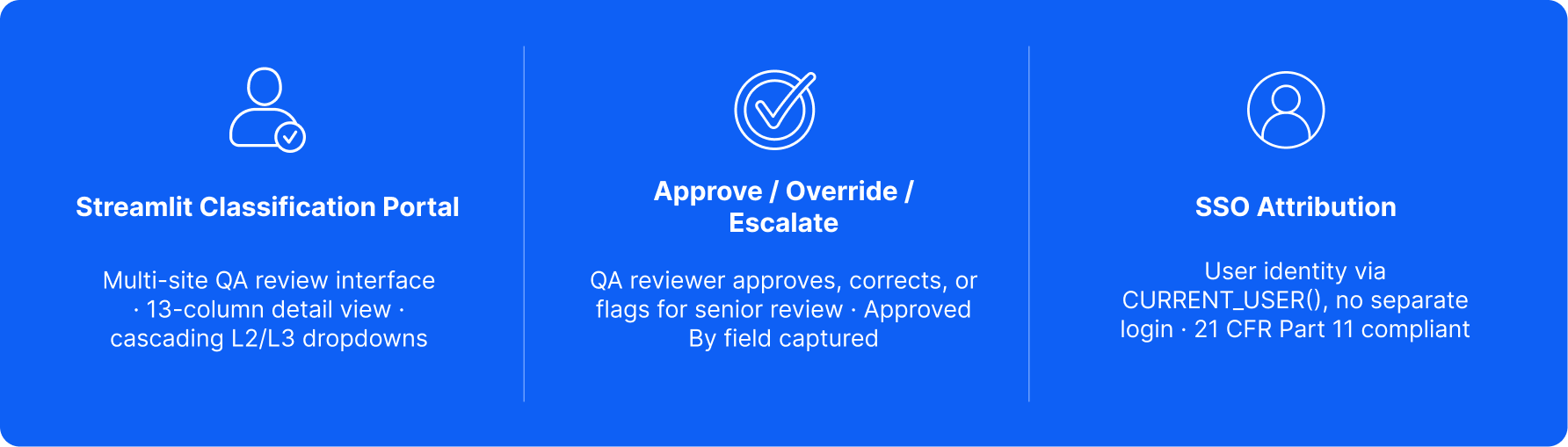
Writes all decisions to an immutable audit trail with SSO user attribution

Everything a regulated quality team needs
Designed for GMP environments. Every capability is governed, auditable, and built to survive an FDA or EMA inspection.
Classifies free-text deviation descriptions into a GMP-aligned L1 → L2 → L3 taxonomy driven from a live database table, not hardcoded. Version-controlled and auditable, with weighted composite confidence scoring at each level.
After classification, the approved category triggers a resolution agent that retrieves the top two relevant corrective action sequences from your historical CAPA library, with regulatory citations, SOP references, and root cause patterns.
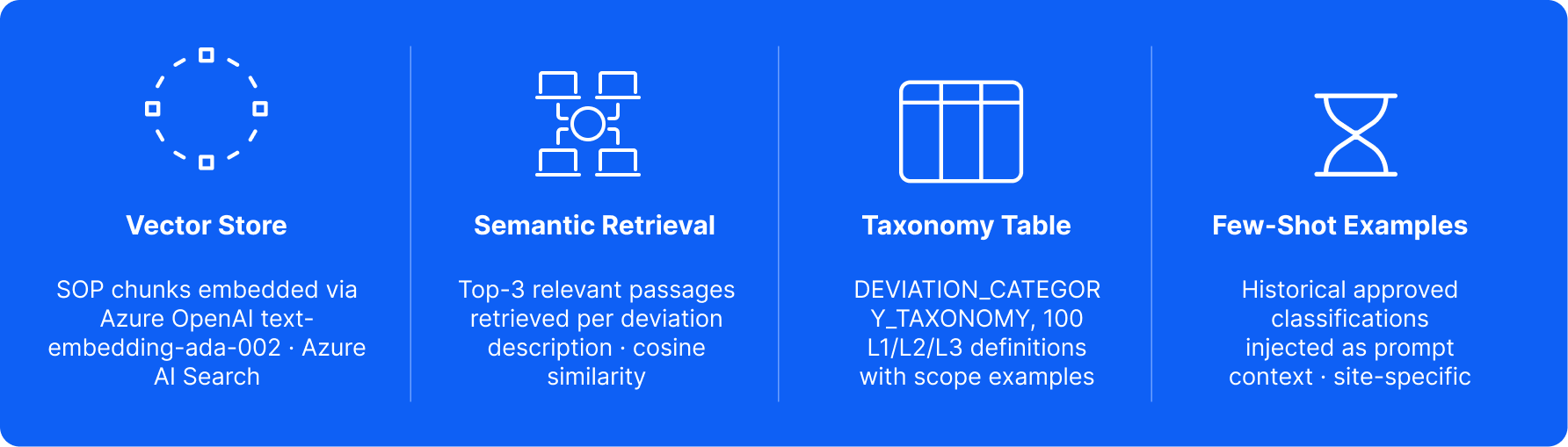
A retrieval-augmented generation engine that ingests your SOPs, CAPA history, and regulatory guidelines into a vector store. The most relevant passages are retrieved and injected into the LLM prompt, grounding every prediction in your own knowledge.
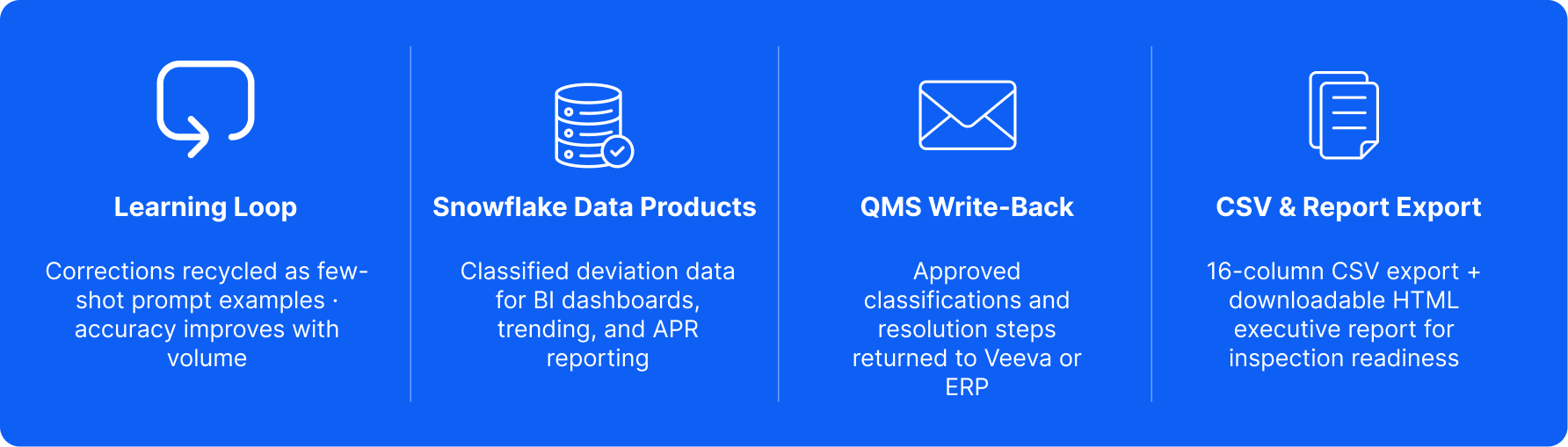
A dedicated reporting tab generates a Cortex-powered narrative executive report on demand: situation summary, business impact by severity, root cause patterns, regulatory exposure, and recommended actions. Downloadable as print-ready HTML/PDF.
A governed QA review portal built on Stream lit where reviewers see the AI prediction, confidence score, and source evidence side-by-side. Approve, correct L1/L2/L3 independently, flag batch loss. Every action is SSO-attributed and timestamp-logged.
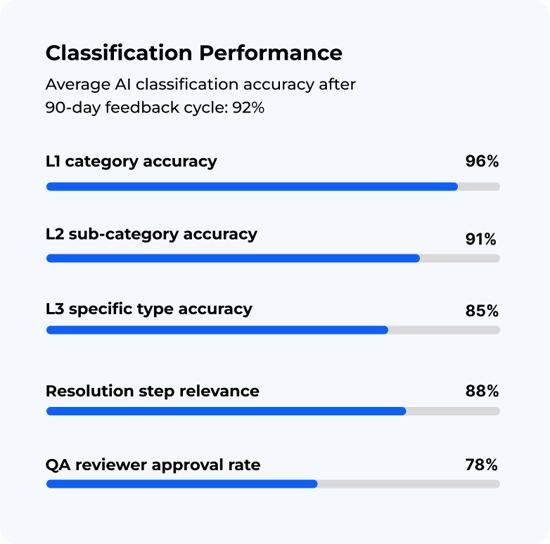
Every QA correction is written to a structured feedback table capturing the AI prediction alongside the human correction at all three levels. Corrections are recycled as few-shot examples and used to fine-tune the model, improving accuracy without manual retraining.
Everything a regulated quality team needs
Designed for GMP environments. Every capability is governed, auditable, and built to survive an FDA or EMA inspection.
70%
Reduction in deviation classification time, from hours to minutes.
Benchmark: CDMO Quality Operations Study, 2024
$455K+
Estimated annual value delivered through efficiency gains and risk reduction.
Based on 500-batch annual volume deployment.
30%
Fewer repeat deviations within 12 months through resolution pattern intelligence.
Benchmark: Roche Quality AI Programme, 2023
< 8 wk
From kick-off to a production-grade system running on your Snowflake environment.
Accelerator-based deployment model
What changes when your quality team uses AI
Measured impacts across people, process, risk, and compliance, not just speed.
1
QA analyst time recaptured
Manual classification that consumed 4-6 hours per analyst per week is reduced to exception-handling. Senior QA time shifts toward investigation quality and CAPA effectiveness.
2
Shorter deviation closure cycles
Consistent, fast classification accelerates CAPA initiation. Teams report 25-40% improvement in average time-to-close for non-critical deviations.
3
Reduced regulatory exposure
Consistent classification eliminates cross-facility discrepancies that attract 483 observations. A complete, SSO-attributed audit trail satisfies 21 CFR Part 11 and EU GMP Annex 11.
4
Cross-site standardization
A single governed taxonomy across all sites ensures identical deviations are classified identically, enabling true cross-site trending and benchmarking for the first time.
5
Executive quality intelligence
AI-generated weekly summaries give leadership a structured narrative view of the deviation landscape, patterns, regulatory exposure, and recommended actions, with no manual compilation.
6
Compounding accuracy over time
The feedback loop means the system gets measurably better with use. Six months of feedback typically lifts accuracy from ~78% at go-live to 92%+, without retraining costs.
The economics of AI-assisted quality
Based on a mid-size manufacturer processing 200-500 quality deviations per month across two sites.
.png?width=1187&height=610&name=Group%20754%20(1).png)
ROI estimates are indicative and based on publicly available pharma operational benchmarks and KPI Partners client deployment data. Actual results vary by organization size and deviation volume.
Built natively on Snowflake. No new infrastructure required.
The entire pipeline runs within your existing Snowflake environment, with optional Azure OpenAI
integration. No data leaves your cloud boundary.
Ready to see it running on your data?
We deploy a working proof-of-concept in your Snowflake environment using your deviation data in under four weeks.
Zero infrastructure cost. Full IP ownership stays with you.
Success Stories
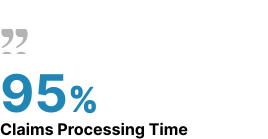
Reduced claims turnaround using AI-driven workflow automation, improving speed and consistency across operations.
![]()
Global Financial Services Leader
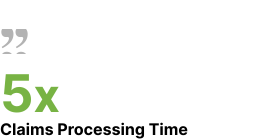
Enabled self-service access to ERP and analytics using governed GenAI, reducing IT dependency and improving decision speed.
![]()
Leading U.S. Beverage Manufacturer
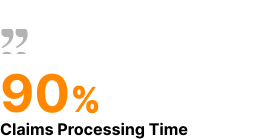
Improved reliability through predictive intelligence and root-cause analysis embedded into operational workflows.
![]()
Global Manufacturing Leader
Data Platform Migration for Modern Analytics
KPI DataBridge Suite is designed to help enterprises modernize their data and analytics infrastructure across:
BI Modernization 🔗
Data Platform Migration 🔗
Data Products 🔗