


by Naresh Meda
What Is A Level-Based Measure?
A level-based measure is a column whose values are always calculated to a specific level of...

by Naresh Meda
What Is A Level-Based Measure?
A level-based measure is a column whose values are always calculated to a specific level of aggregation. Here is an example of a level-based measure using a Products and Revenue table. A level-based hierarchy is created for Products as follows:
By default, when we drill down within the products hierarchy from Brand level to Product level, the corresponding Revenue drills down to Product level.

by Madan Thota
Endeca Information Discovery (EID) is a data discovery tool that helps business analysts to rapidly explore relevant data....
by Madan Thota
Endeca Information Discovery (EID) is a data discovery tool that helps business analysts to rapidly explore relevant data. If you are already using Oracle Business Intelligence Enterprise Edition (OBIEE) and wish to reuse the BI data models from Endeca Information Discovery, here are the options. The primary difference between both tools is that one is used for pre-defined analytics while the other is used for having a conversation with your data (analytics vs information discovery). The overall goal for both approaches is to get the most value out of the data available.

by Puneet Aggarwal
Many customers have real-time reporting requirements that are analytic in nature. Essentially, they have a real-time...
by Puneet Aggarwal
Many customers have real-time reporting requirements that are analytic in nature. Essentially, they have a real-time report as a starting point for a more detailed real-time analysis which can go a few levels deep. Shown below is a generic example of one such requirement for Account Analysis.
by Shiva Molabanti
Prerequisites:
- OBIEE 11.1.1.7.1 (If your version of Oracle BI EE is not 11.1.1.7.1, download Patch 16556157: OBIEE...
by Shiva Molabanti
Prerequisites:
- OBIEE 11.1.1.7.1 (If your version of Oracle BI EE is not 11.1.1.7.1, download Patch 16556157: OBIEE BUNDLE PATCH 11.1.1.7.1 from My Oracle Support).
- To support Oracle BI Mobile App Designer with Oracle BI Web Catalog, Apply OBIEE 11.1.1.7.1 MLR Patch 17004920.
- Download Oracle BI Mobile App Designer Patch 17220944 from My Oracle Support.
Installation Steps:
- Stop All OBIEE 11G services (Weblogic Admin Server, Managed Server and OPMN services).
- Apply OBIEE 11.1.1.7.1 MLR Patch 17004920 using OPatch Utility.
- Apply Oracle BI Mobile App designer Patch 17220944 using OPatch Utility.
- Deploy the Oracle BI Mobile App Designer (MAD) manually using Weblogic Configuration Assistant as shown below.
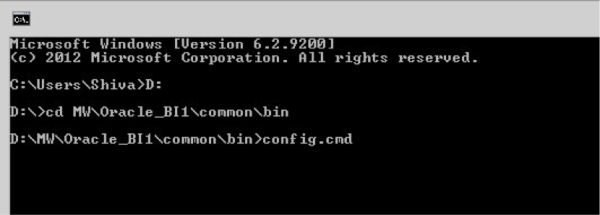
- Open Command prompt window and Navigate to: <MW_HOME>\Oracle_BI1\common\bin
- Run "config.bat" to start the WebLogic Configuration Assistant Tool.
On welcome screen, select ‘"Extend an existing WebLogic domain" and click "Next."
by Shiva Molabanti
The Oracle Data Integrator platform integrates into the broader Fusion Middleware platform and becomes a key component...
by Shiva Molabanti
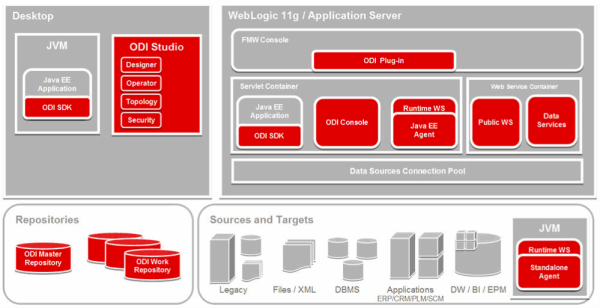
The Oracle Data Integrator platform integrates into the broader Fusion Middleware platform and becomes a key component of this stack. Oracle Data Integrator provides it's run-time components as Java EE applications, enhanced to fully leverage the capabilities of the Oracle WebLogic Application Server. Oracle Data Integrator components include the FMW exclusive features for Enterprise-Scale Deployments, high availability, scalability, and hardened security.
by Veera Reddy Ramidi
This blog introduces and explains the detailed step by step process for executing the Domain Load to Business...
by Veera Reddy Ramidi
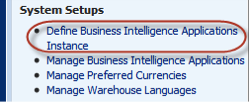
This blog introduces and explains the detailed step by step process for executing the Domain Load to Business Analytics Warehouse. Here, we are illustrating for the Student information Analytics data using the new OBIA 11g which is supported only for PeopleSoft 9.0 Campus Solutions. This blog can be used similarly for any other Analytics using OBIA 11g.
by Sharath Venkataranga
The most common question faced by any ETL developer or a Data Warehouse project implementer is always related to...
by Sharath Venkataranga
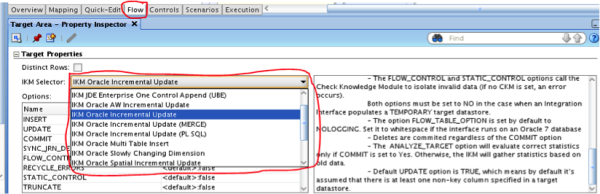
The most common question faced by any ETL developer or a Data Warehouse project implementer is always related to performance. Whatever the tool may be, and however fast the job may be running, the end user will always desire something which is a little faster and quicker.


by Naresh Meda
What Is A Level-Based Measure?
A level-based measure is a column whose values are always calculated to a specific level of aggregation. Here is an example of a level-based measure using a Products and Revenue table. A level-based hierarchy is created for Products as follows:
By default, when we drill down within the products hierarchy from Brand level to Product level, the corresponding Revenue drills down to Product level.
by Madan Thota
Endeca Information Discovery (EID) is a data discovery tool that helps business analysts to rapidly explore relevant data. If you are already using Oracle Business Intelligence Enterprise Edition (OBIEE) and wish to reuse the BI data models from Endeca Information Discovery, here are the options. The primary difference between both tools is that one is used for pre-defined analytics while the other is used for having a conversation with your data (analytics vs information discovery). The overall goal for both approaches is to get the most value out of the data available.
by Puneet Aggarwal
Many customers have real-time reporting requirements that are analytic in nature. Essentially, they have a real-time report as a starting point for a more detailed real-time analysis which can go a few levels deep. Shown below is a generic example of one such requirement for Account Analysis.
by Shiva Molabanti
Prerequisites:
- OBIEE 11.1.1.7.1 (If your version of Oracle BI EE is not 11.1.1.7.1, download Patch 16556157: OBIEE BUNDLE PATCH 11.1.1.7.1 from My Oracle Support).
- To support Oracle BI Mobile App Designer with Oracle BI Web Catalog, Apply OBIEE 11.1.1.7.1 MLR Patch 17004920.
- Download Oracle BI Mobile App Designer Patch 17220944 from My Oracle Support.
Installation Steps:
- Stop All OBIEE 11G services (Weblogic Admin Server, Managed Server and OPMN services).
- Apply OBIEE 11.1.1.7.1 MLR Patch 17004920 using OPatch Utility.
- Apply Oracle BI Mobile App designer Patch 17220944 using OPatch Utility.
- Deploy the Oracle BI Mobile App Designer (MAD) manually using Weblogic Configuration Assistant as shown below.
- Open Command prompt window and Navigate to: <MW_HOME>\Oracle_BI1\common\bin
- Run "config.bat" to start the WebLogic Configuration Assistant Tool.
On welcome screen, select ‘"Extend an existing WebLogic domain" and click "Next."
by Shiva Molabanti
The Oracle Data Integrator platform integrates into the broader Fusion Middleware platform and becomes a key component of this stack. Oracle Data Integrator provides it's run-time components as Java EE applications, enhanced to fully leverage the capabilities of the Oracle WebLogic Application Server. Oracle Data Integrator components include the FMW exclusive features for Enterprise-Scale Deployments, high availability, scalability, and hardened security.
by Veera Reddy Ramidi
This blog introduces and explains the detailed step by step process for executing the Domain Load to Business Analytics Warehouse. Here, we are illustrating for the Student information Analytics data using the new OBIA 11g which is supported only for PeopleSoft 9.0 Campus Solutions. This blog can be used similarly for any other Analytics using OBIA 11g.
by Sharath Venkataranga
The most common question faced by any ETL developer or a Data Warehouse project implementer is always related to performance. Whatever the tool may be, and however fast the job may be running, the end user will always desire something which is a little faster and quicker.
