


Redefine what's
possible
Migrate from Qlik to Power BI
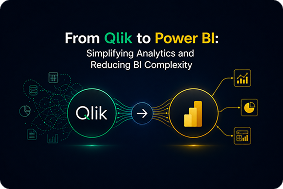
Modernize with confidence. Automate your move with the KPI Partners Migration Accelerator, powered by Microsoft Fabric and AI-driven conversion. It assesses your Qlik estate, converts load scripts, expressions, and data models automatically, and validates every number before go-live, so your teams keep working while the migration happens behind the scenes.
Migration without starting from scratch
Your Qlik dashboards run the business every day. Moving them to Power BI usually means complex QVD scripts, blown timelines, budget overruns, and the fear that a number breaks along the way. KPI Partners' Qlik to Power BI Migration Accelerator removes that risk. It automates conversion of load scripts, expressions, and data models, translates Qlik set analysis into Power BI DAX, and validates data and logic before handover, so you land on a governed, AI-ready Power BI and Microsoft Fabric environment your teams trust from day one.

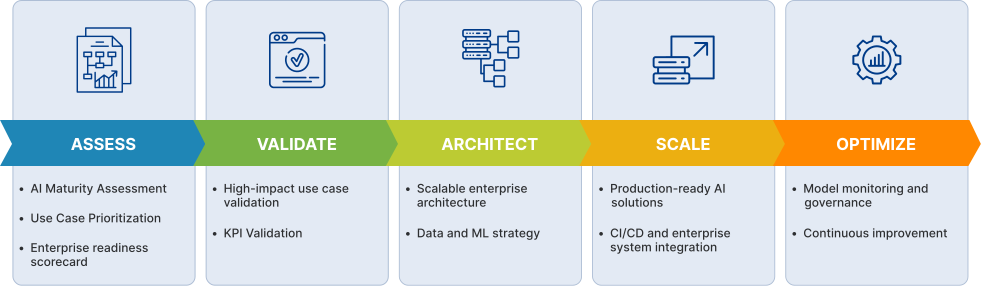
Migration in three automated steps
One accelerator, one continuous pipeline, from inventory to production.


Qlik to Power BI Migration Accelerator
See how this turns out in the real world.
What powers the accelerator
Purpose-built for Qlik to Power BI migrations, engineered for complex Business Intelligence (BI) estates.
Automated calculation conversion
Qlik set-analysis expressions and load scripts become refined Power BI DAX, with anything that needs a human eye clearly flagged.
Visual and layout mapping
Qlik worksheets and dashboards are mapped to Power BI, keeping the structure your business already knows and reads every day.
Data model optimization
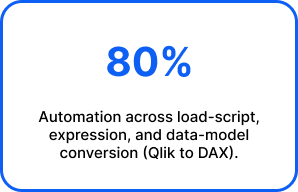
QVD-based data models are rebuilt on a Microsoft Fabric Lakehouse across Bronze, Silver, and Gold layers, automating up to 80% of conversion.
Governance-ready output
Automated validation of data, schema, and transformation logic delivers 100% migration fidelity, so governance travels with the migration, not bolted on afterward.

The value of the accelerator
Why move to Power BI now?
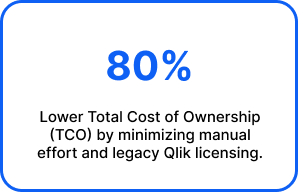
The move pays back in cost, speed, and confidence, and it opens the door to what comes next on Microsoft Fabric.
How a migration project works
A structured, phased path from your existing Qlik estate to a validated Power BI and Microsoft Fabric environment.
Phase 1
Assessment
- Scan the Qlik environment and map application dependencies
- Extract metadata for fields, measures, expressions, and visuals
- Generate a compatibility and effort report before migration begins
- Define migration scope and a phased execution roadmap
Phase 2
Deploy the Data Layer
- Migrate QVD load scripts and the Qlik data model to a Microsoft Fabric lakehouse
- Convert Qlik load logic into Fabric SQL across the Bronze, Silver, and Gold layers
- Identify QVD dependencies and establish the target data model
- Validate and reconcile data and schema against the source
Phase 3
Power BI Deployment
- Convert Qlik expressions and set analysis into Power BI DAX
- Auto-build and deploy the Power BI semantic model
- Generate the report and visual layer from extracted worksheet metadata
- Package everything as a ready-to-open Power BI Project (PBIP)
Featured Case Studies & Blogs
Real Qlik to Power BI migrations delivered with the KPI Partners Accelerator.
Frequently asked questions
The questions data and analytics leaders ask before they move.
How do we know if Qlik to Power BI is a good fit?
If you run Qlik Sense or QlikView with dashboards the business depends on, you are a strong candidate. The complimentary Discovery and Readiness Assessment confirms scope, effort, and timeline against your own environment before any commitment.
How is this different from a traditional migration?
Traditional migrations rebuild every dashboard and load script by hand, which stretches timelines and drains skilled resources. The KPI Partners Accelerator automates load-script, expression, and data-model conversion, then applies validation-driven execution, so you cut effort and cost by 60 to 75% while maintaining 100% migration fidelity.
What Qlik assets can I migrate?
Qlik Sense and QlikView applications, QVD-based load scripts and data models, Qlik set-analysis expressions, master items, and variables, and both on-premises and cloud Qlik deployments.
Do I need Power BI or Microsoft Fabric already deployed?
No. The accelerator targets Power BI Project (PBIP) files, Power BI semantic models, and the Microsoft Fabric Lakehouse with Bronze, Silver, and Gold layers. Our team helps you stand up the target environment as part of the program.
How long does a typical migration take?
Organizations can assess migration readiness, validate automated conversion, and define a structured execution roadmap in as little as four weeks through the Quick Start Program, including a complimentary Discovery and Readiness Assessment. Full program timelines scale with the size and complexity of the Qlik estate.
How is security handled after migration?
Qlik permissions and access patterns are mapped to Power BI and Microsoft Fabric governance models, then validated by KPI Partners experts before go-live, so access and data lineage match expectations exactly.
Modernize Without breaking the business
Get a free Qlik to Power BI Migration Assessment and see exactly what an automated migration looks like for your environment.
Success Stories
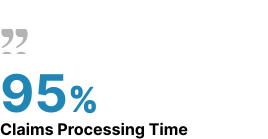
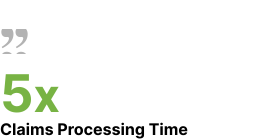
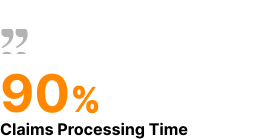
Reduced claims turnaround using AI-driven workflow automation, improving speed and consistency across operations.
![]()
Global Financial Services Leader
Enabled self-service access to ERP and analytics using governed GenAI, reducing IT dependency and improving decision speed.
![]()
Leading U.S. Beverage Manufacturer
Improved reliability through predictive intelligence and root-cause analysis embedded into operational workflows.
![]()
Global Manufacturing Leader
Data Platform Migration for Modern Analytics
KPI DataBridge Suite is designed to help enterprises modernize their data and analytics infrastructure across:
BI Modernization 🔗
Data Platform Migration 🔗
Data Products 🔗