


Redefine what's
possible
Move from Tableau to Power BI without losing a single insight
Save up to 85% on migration time and cost with KPI Partners' AI-powered accelerator for automated Tableau-to-Power BI conversion.
Migration without starting from scratch
Your Tableau dashboards run the business every day, and moving them to Power BI has usually meant months of manual rebuilds, rising budgets, and the worry that a report might break along the way. The KPI Partners Migration Accelerator takes that risk off the table. It reads your Tableau estate, converts reports and datasets automatically, translates complex calculations into Data Analysis Expressions (DAX), and reconciles every number before handover, so you land on a clean, right-sized Power BI environment your teams trust from day one, not a copy of yesterday's clutter.
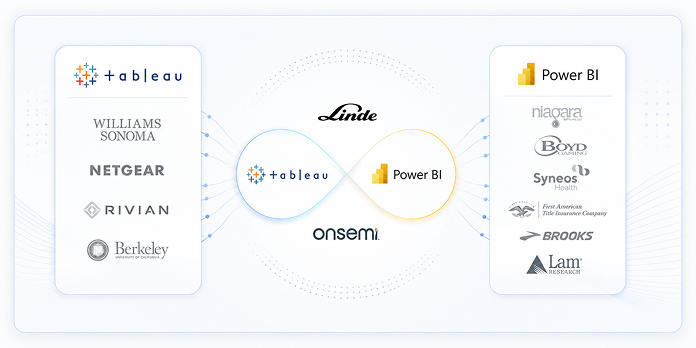
Trusted by leaders who run on
Tableau and Power BI

Migration in three automated steps
One accelerator, one continuous pipeline, from inventory to production.


Tableau to Power BI Migration Accelerator
See how this turns out in the real world.
What powers the accelerator
Purpose-built for Tableau to Power BI migrations, engineered for complex Business Intelligence (BI) estates.
Automated calculation conversion
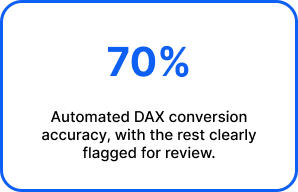
Complex Tableau calculations become refined DAX, with anything that needs a human eye clearly flagged, so nothing slips through silently.
Visual and layout mapping
Reports and dashboards are mapped to Power BI, keeping the structure your business already knows and reads every day.
Data model optimization
Datasets and semantic models are rebuilt for Power BI, cutting rebuild effort by up to 50% through automated dataset migration.
Governance-ready output
Security roles, lineage, and a full audit trail travel with the migration, so governance is built in, not bolted on afterwards.

The value of the accelerator
Why move to Power BI now?
How a migration project works
A structured, phased path from your existing Tableau estate to a validated Power BI Premium environment.
Phase 1
Assessment and Rationalization
- Run the assessment on your Tableau platform and extract metadata
- Categorize reports by priority, relevance, and usage
- Rationalize Key Performance Indicators (KPIs) and define the scope
- Build a clear, phased migration roadmap
Phase 2
Automated Migration
- Migrate Tableau datasets to Power BI using the KPI Partners Accelerator
- Translate complex calculations into DAX through GenAI
- Migrate reports and dashboards to Power BI
- Evaluate accuracy and apply manual intervention only where needed
Phase 3
Security and Change Management
- Implement and verify security, role mapping, and permissions
- Validate migrated reports and dashboards end to end
- Support change management and user adoption
- Hand over a clean, production-ready Power BI environment
Featured Case Studies
Real Tableau to Power BI migrations delivered with the KPI Partners Accelerator.
Modernizing Enterprise BI: Migrating a 120+ Workbook Tableau Estate to Power BI Across Three Global Regions

Frequently asked questions
The questions data and analytics leaders ask before they move.
How do we know if Tableau to Power BI is a good fit?
If you are running Tableau Server or Tableau Cloud with dashboards the business depends on, you are a strong candidate. The complimentary Discovery and Readiness Assessment confirms scope, effort, and timeline against your own environment before any commitment.
How is this different from a traditional migration?
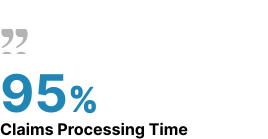
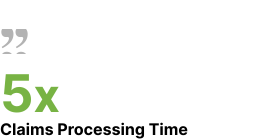
Traditional migrations rebuild every report by hand, which stretches timelines and drains skilled resources. The KPI Partners Accelerator automates dataset migration and DAX conversion, then applies expert validation, so you cut effort and cost by 70-95% while quality stays high.
What Tableau assets can I migrate?
Tableau Server and Tableau Cloud environments, Tableau Desktop workbooks and dashboards, Tableau data sources and calculations, and Tableau security roles and permissions.
Do I need Power BI or Microsoft Fabric already deployed?
No. The accelerator targets Power BI Premium, Power BI semantic models, the Power BI service and workspaces, and Microsoft Fabric; Our team helps you stand up the target environment as part of the program.
How long does a typical migration take?
A migration of 20 to 25 Tableau workbooks typically runs about 13 to 17 weeks end to end, across assessment and rationalization, automated migration, and security and change management.
How is security handled after migration?
Tableau security roles and permissions are mirrored in Power BI with precise role mapping, then manually verified by KPI Partners experts before go-live, so access matches the original exactly.
Move off Tableau without breaking the business
Get a free Tableau to Power BI Migration Assessment and see exactly what an automated migration looks like for your environment.
Success Stories
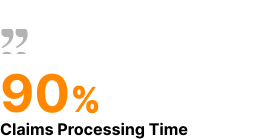
Reduced claims turnaround using AI-driven workflow automation, improving speed and consistency across operations.
![]()
Global Financial Services Leader
Enabled self-service access to ERP and analytics using governed GenAI, reducing IT dependency and improving decision speed.
![]()
Leading U.S. Beverage Manufacturer
Improved reliability through predictive intelligence and root-cause analysis embedded into operational workflows.
![]()
Global Manufacturing Leader
Data Platform Migration for Modern Analytics
KPI DataBridge Suite is designed to help enterprises modernize their data and analytics infrastructure across:
BI Modernization 🔗
Data Platform Migration 🔗
Data Products 🔗