Key takeaways:
- One end-to-end trace, built into three stakeholder views, shows whether an agent is healthy, right and worth what it costs; we track cost per accepted answer, not cost per call.
- Governance holds when it lives in platform controls, not prompts: Give every agent the least privilege it needs, carry the user's identity into every query and require human approval for consequential actions.
- Start with one agent in one account and earn each step of complexity; A twelve-week KPI Partners AgentOps engagement ends with four measurable numbers that let technology leaders decide on evidence.
Go-Live Is Not the Finish Line; It Is Where AgentOps Earns Its Keep
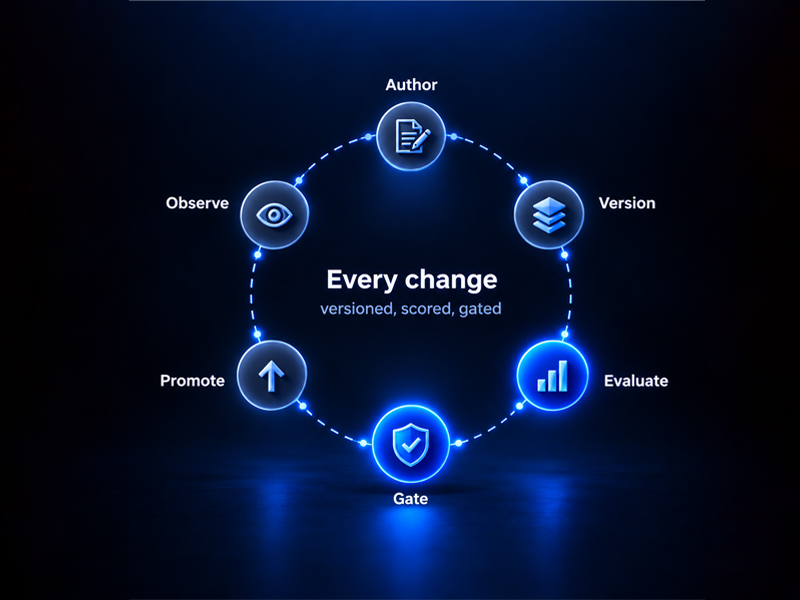
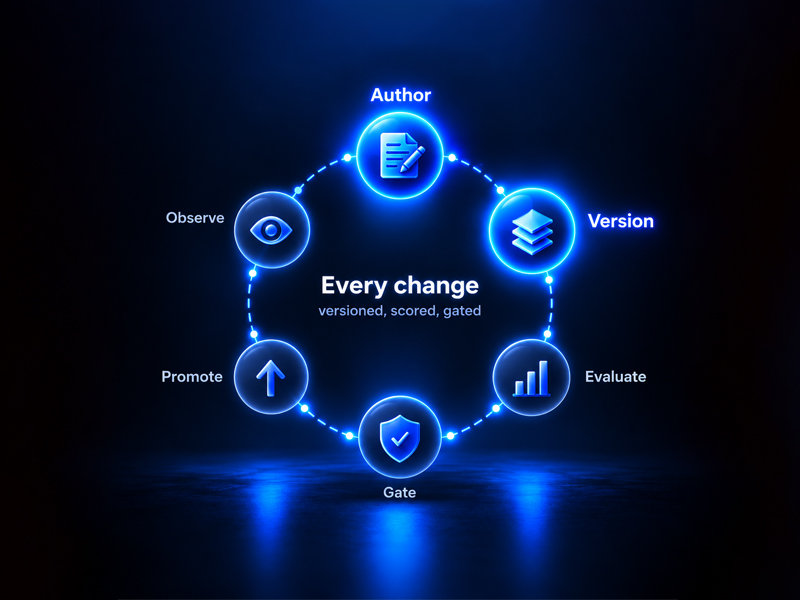
Once an agent is live, technology leaders become accountable for every unexplained answer, quality regression and unexpected dollar it consumes. AgentOps turns those production risks into an operating discipline: Trace every answer, govern every action and scale only when the evidence supports it.
Part 1 of this series made the case for an operating discipline built on five layers and three planes, and Part 2 covered the two controls that decide cost and trust before an agent ships: Model routing and the release gate. This final part covers what happens after: What each stakeholder sees, how permissions hold when the model misbehaves, and how to scale from one agent to many.
Build One Trace, Then Three Views
Traditional monitoring tells you whether the system is up; Agent telemetry tells you whether its answers can be trusted. We trace every request end to end, so anyone with the right access can replay the path an answer took, see which model and tool produced each step, and attribute its cost to the span that incurred it. Raw traces are dense, so we build the same data into three views, each designed around the decision its audience has to make.
|
Audience |
The question they ask |
What their view shows |
|
Executive sponsor |
Is this agent worth what it costs, and is it safe? |
Return on Investment (ROI) narrative, spend against budget, and the trend in risk and compliance findings |
|
Business Subject Matter Expert (SME) and product owner |
Are the answers right, and where are they wrong? |
Judge scores by quality dimension, the hard-case review queue, and user ratings by topic |
|
Platform and operations team |
Is the service healthy right now? |
Latency against targets, error and incident rates, provider health, cache hits and cost by model |
The result is one source of truth read three ways, so every stakeholder works from the same numbers.
Track Cost per Accepted Answer, Not Cost per Call
The quality view usually earns its place within weeks. A Large Language Model (LLM) judge scored every answer from one to five on faithfulness, relevance and completeness. Faithfulness averaged 4.5, so answers stayed grounded in the sources they retrieved. Completeness, however, ranged from 4.1 for the strongest large model down to 2.3 for the smallest model in the routine pool.
A cost-only dashboard would have called the routing from Part 2 a success while users got accurate but incomplete answers. That is why we track cost per accepted answer, not cost per call: A cheap answer nobody can use was never a saving.
Design Governance That Holds When the Model Misbehaves
Gartner expects 40% of enterprises to demote or decommission autonomous AI agents by 2027 because of governance gaps. Permissions in an agentic system work at two levels, and both must be designed before the incident, not after it.
Scope Every Agent to Its Narrowest Grant
Each sub-agent and tool receives the least privilege it needs. A billing agent can read invoices but cannot change a customer's plan, and an escalation path can open a human-review ticket but cannot close one. If the model is ever manipulated, the tool still cannot act outside its grant.
Carry the User's Identity Into Every Query
One agent serves many people, so each user's identity must flow through every query made on their behalf. Where the platform supports it, the agent queries as the user and existing row-level and column-level policies apply. Where it does not, the application injects the authenticated user identifier as a trusted filter that never comes from the model's output, since a prompt injection can rewrite anything the model produces.
Keep Humans on Consequential Actions
Consequential actions keep a human in the loop, and every tool call and data access lands in an audit table that feeds the views above. As agents multiply, most organizations reach a point where nobody can say how many are running, who owns them or what data they touch. Our answer is a cross-functional AI governance group of engineering, security, legal and business owners that sets standards centrally and leaves execution with the teams, formed before that point arrives.
Start Simple and Earn Each Step of Complexity
The deployment pattern should follow real requirements, not ambitions, so we place every program on two dimensions: How strictly environments must be isolated, and how many specialized agents must cooperate.
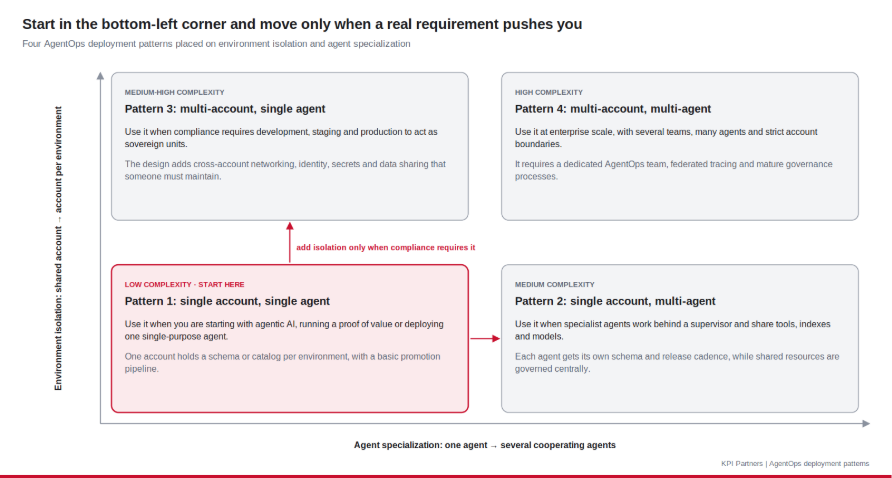
Most clients should start with one account and one agent, a schema or catalog per environment and a basic promotion pipeline. A supervisor with specialist sub-agents is the natural next step once a second business domain joins. We recommend keeping those sub-agents from calling each other directly; Every additional conversation path adds nondeterminism that operations teams must later diagnose.
Separate accounts per environment become necessary when compliance requires development, staging and production to act as sovereign units, bringing cross-account networking, identity and secrets someone must maintain. Many agents across many accounts only makes sense with a dedicated AgentOps team and mature governance.
The same mistakes turn up in every pattern, and each feels reasonable when it is made.
|
What we see |
What we recommend |
|
A first agent scoped to answer every employee question |
One well-scoped use case with a measurable outcome and a named owner |
|
A supervisor with five sub-agents where a sequential chain would do |
A deterministic chain first, with orchestration added only where the next step is uncertain |
|
Free-form Structured Query Language (SQL) written by the agent for a question a parameterized query could answer |
LLM-driven tools reserved for the mapping problems that need them |
|
Agents holding broad credentials to every endpoint |
A governed tool registry that grants each agent its narrowest scope |
|
Prompts, tools and routing rules changing outside version control |
Every component versioned as one agent release, with rollback by alias |
|
Quality judged by manual spot checks |
A programmatic evaluation suite that gates every release and re-runs on a schedule |
|
No per-request budgets or rate limits |
A gateway that enforces a soft alert and a hard cap, and attributes spend to each span |
Each mistake trades a little speed today for a lot of operational effort later. The practices that avoid them also compound: A reference architecture, a shared base agent class and a reusable evaluation harness built for the first agent settle most of the decisions for the next ten.
Map the Architecture to the Platform You Already Run
Because the Part 1 architecture is defined by capabilities, not products, it maps onto Databricks, Snowflake, Amazon Web Services (AWS) and Azure alike. The table identifies the native service we would evaluate first on each platform, as named in vendor catalogs in October 2026; The final choice depends on the client's existing data estate, security model and operating capabilities.
|
Capability |
Databricks |
Snowflake |
AWS |
Azure |
|
Agent runtime |
Agent Bricks and Databricks Apps |
Cortex Agents with Cortex Analyst and Cortex Search |
Amazon Bedrock AgentCore |
Azure AI Foundry Agent Service |
|
Gateway and routing |
Unity AI Gateway, extended with LiteLLM |
LiteLLM on Snowpark Container Services in front of Cortex LLMs |
Bedrock with LiteLLM or a custom router |
API Management AI gateway, extended with LiteLLM |
|
Evaluation |
MLflow GenAI evaluation and LLM judges |
Cortex Agent Evaluations |
Bedrock evaluations |
Azure AI Evaluation SDK |
|
Tracing |
MLflow Tracing |
Snowflake AI Observability |
AgentCore Observability and CloudWatch |
Foundry tracing with Application Insights |
|
Guardrails |
AI Gateway guardrails |
Cortex Guard |
Bedrock Guardrails |
Azure AI Content Safety and Prompt Shields |
|
Governance |
Unity Catalog |
Horizon Catalog |
IAM and Lake Formation |
Microsoft Entra ID and Purview |
|
Release automation |
Declarative Automation Bundles |
Snowflake CLI, Git integration and Tasks |
CodePipeline and CodeBuild |
Azure DevOps or GitHub Actions |
We recommend a native-first approach. A client whose data estate runs on Snowflake should keep agents, traces and evaluations next to that data, and add AWS or Azure services only where its release pipelines or on-call operations already live. Moving a component later is then a change, not a rebuild, provided the three planes were designed as separate concerns from day one.
Judge the Operating Model on Four Numbers
We usually meet clients at one of two starting points. Some have no agent in production, so we build the first one and switch on its operating cycle before go-live, far cheaper than retrofitting. Others already have an agent serving users, so we start with operations and leave the build alone until the release gate is in place.
Either way, a first AgentOps engagement runs for about twelve weeks. Weeks one and two set the use case, its Key Performance Indicators (KPIs) and test questions, and stand up our reference implementation as a baseline. Weeks three to six build the agent on governed data and native tools.
Weeks seven to nine wire in the evaluation gate, routing and cost caps and measure them. In the last three weeks we settle the architecture on that evidence, switch on alerts and hand over a runbook.
Every proof of value ends with four numbers: The monthly cost of running the operating cycle, the time from a merged change to a gated production release, the time from a failing alert to the previous version serving users again, and the share of seeded regressions the gate catches. Those numbers let a Chief Information Officer (CIO) choose an architecture on evidence rather than on vendor claims. Our reference implementations and evaluation harnesses run natively on Databricks, Snowflake, AWS and Microsoft Azure, so what we leave behind fits the platform a client already trusts.
Build the Discipline That Lets Agents Survive Production
This series has made one argument from three angles: Agents need their own operating discipline, routing and the release gate decide cost and trust, and production is where observability and governance prove their worth.
The decision is not whether the next model will be better; It almost certainly will be. The decision is whether the organization can prove that every agent release is accurate, affordable, auditable and reversible. Agents that survive production are versioned, measured and gated as rigorously as any other system the business depends on, and that is the operating discipline AgentOps by KPI Partners is built to establish.