Author: Aishwarya Iyyengar: Assistant Manager - Content Marketing
Key takeaways:
- AI pilots rarely stall because the model falls short; momentum is usually lost in the plan around it.
- Five gates, with clear owners and evidence-based exit tests let funding follow measurable value and weaker ideas stop early.
- KPI Partners combines Enterprise AI advisors with forward-deployed engineers to move selected pilots from strategy through production and adoption.
Fund the Gates, Not the Pilot
A common assumption among leadership is that AI production stalls because the model/technology is not ready yet. However, the models are rarely a problem; the plan around them usually is. A pilot funded as one large bet survives on enthusiasm. A pilot funded as a sequence of gates will survive on evidence, and that is a far better position for any executive to be in.
Treat Production Readiness as a Leadership Decision
A 2026 Gartner survey found that 45% said their AI investments leaned toward productivity, while only 20% leaned toward decision quality. Gartner warned of a “perception gap” in which finance leaders report progress on AI adoption while boards see limited strategic impact and urged CFOs to define clear metrics tied to enterprise objectives. That is exactly the intent of these five gates: establish the business outcome and baseline before investment expands, then release further funding only when measured value supports it.
Spot the Three Patterns That Slow Pilots Down
Choose the Use Case for the Business Number, Not the Demo
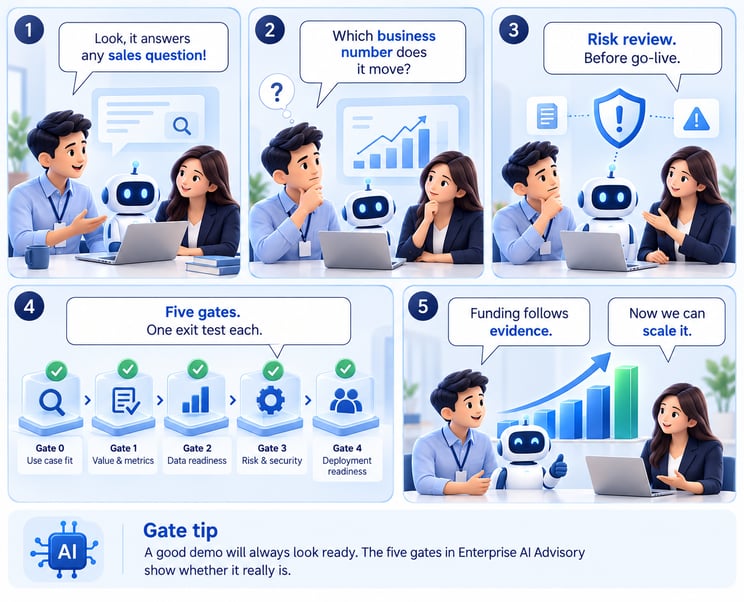
Some pilots are picked because they demo well. A demo earns applause; A business number earns budget. If no one can say which number the pilot is meant to move, and who owns it, the pilot is a showcase rather than a step toward production.
Set the Baseline Before the Build
Without a measured starting point, nobody can show that the AI made a difference. For a Chief Financial Officer (CFO), this is the heart of the matter: A gain that cannot be measured against a baseline is a gain that cannot be funded twice.
Bring Risk to the Design Table on Day One
When security, privacy, and governance reviews arrive at the end, they block go-live. When they arrive at the start, they shape the design, and the same review becomes a source of confidence instead of a late surprise.
Your risk and security leaders are most valuable before the build, not after it.
All three patterns share one trait: Each is a decision that was deferred. A gate model moves those decisions to the front, where they cost the least.
Release Funding One Gate at a Time
The Enterprise AI Advisory approach at KPI Partners organizes the path into five gates, each with a time-bound exit test. Passing a gate releases the next investment; missing the threshold triggers a redesign or an early stop. The suggested timeframes below are planning ranges rather than rigid deadlines and should be adjusted for the use case, data environment, and regulatory requirements.
Gate 0: Value Hypothesis
The business outcome, executive owner, users, baseline, risk boundaries, and funding logic are agreed before the build begins. Security, privacy, legal, and governance leaders help shape the use case from day one.
Exit test: A signed-off outcome, baseline, accountable owner, initial risk assessment, and agreed success thresholds.
Gate 1: Data and Feasibility
The approach is tested on real data inside security and governance guardrails. The team validates the business definitions, documents, policies, and rules the AI system will reason over and not simply whether a model can produce a plausible answer. Evaluation criteria should cover quality, reliability, safety, latency, and expected run cost.
Exit test: Agreed quality and safety thresholds met on a representative evaluation set, with data access, context, controls, and a cost range confirmed.
Gate 2: Pilot in Production
A real group of users runs the solution in its actual workflow. Evaluation, observability, guardrails, support, and incident procedures are in place. For agentic workflows, a human approves actions above an agreed risk level.
Exit test: Adoption, task quality, reliability, safety, and operating targets are met during a defined production trial.
Gate 3: Value Measured
Results are compared with the Gate 0 baseline. Finance and the business owner validate the gain, including any quality, revenue, cost, risk, or cycle-time improvement, and revise the business case where necessary.
Exit test: A measured, finance-validated gain against baseline that supports the next funding decision.
Gate 4: Scale
The solution expands to more users, processes, and domains under a clear operating model. At this stage, teams need service levels, change controls, cost monitoring, and clear ownership. Techniques such as dynamic model routing can direct each request to the model that provides the appropriate balance of capability, speed, and cost, helping make unit economics visible and manageable.
Exit test: Ownership, service levels, unit economics, risk controls, and the scaling roadmap are approved.
Together, the gates turn one large budget request into a series of smaller, evidence-backed decisions. The CFO sees spending tied to proof. The business owner knows what “done” means at each stage. The risk leader shapes the design from Gate 0 rather than reviewing it at the end. The technology team has explicit quality, observability, safety, and cost thresholds. And the CEO gets a clear answer to the question every board eventually asks: What did this AI program return?
KPI Partners closes the gap between advice and execution by pairing advisors with forward-deployed engineers (FDEs) who own the journey from the business question through production and adoption. Rather than handing over a strategy deck at Gate 0, FDEs work alongside the client team to build, validate, and operationalize the solution through the production gates. KPI Partners says its Enterprise AI Lab and FDE model can move a proof of concept into production in 90 days against finance-validated KPIs.
Have Pilots Running? Lay the Gates Over Them
Many enterprises are already mid-plan, with pilots in flight. That is not a reason to restart. The gates can be applied as a diagnostic lens over existing work. Review each pilot against value, feasibility, production readiness, measured outcomes, and scale economics; add missing baselines and controls; help the strongest pilots advance; and stop the rest early. Stopping early is not a setback. It releases budget and attention for the ideas that have earned their next gate.
KPI Partners applies this approach across enterprises and global capability centers (GCCs), helping teams connect AI modernization priorities with governed execution and measurable outcomes. Advisors and forward-deployed engineers work alongside client teams through implementation and adoption, reducing the handoffs where business intent is often lost and turning the five-gate framework into an executable path rather than a presentation.
The outcome is measurable value. For a North American commercial and retail bank managing more than $45 billion in assets, the starting point included rising fraud losses, a 22% false-positive rate, and manual investigation backlogs. KPI Partners established fraud-loss reduction, false-positive optimization, and regulatory transparency as measurable objectives, then implemented real-time scoring, behavioral analysis, cross-channel signals, automated case prioritization, and explainable AI. Within nine months, the bank reduced fraud losses by 32%, cut false positives by 41%, and achieved $18 million in annualized savings. In gate terms, the baseline and objectives made the investment testable at Gate 0; the measured results supplied the evidence for Gate 3 and the case for scale.
Fund Evidence and Let Momentum Follow
The leaders who get the most from AI will not be those who run the most pilots. They will be those who fund the right pilots one gate at a time, establish the baseline before the build, involve risk from Gate 0, and define production controls before users depend on the solution. Pair that discipline with engineers who remain accountable through implementation and adoption, and each funding decision becomes easier to defend. Fund evidence instead of enthusiasm, and momentum follows because every gate passed represents a result the business can measure, govern, and trust.