Author: Shiva Molabanti, VP - Technology and Client Services
Key takeaways:
- In most enterprises, “revenue,” “active customer,” and “margin” don’t have one definition, they have three or four, spread across a BI semantic model, a dbt metric, a dashboard calculation, and now a prompt. A human analyst navigates that ambiguity from memory; an AI agent picks whichever definition it reaches first and answers with full confidence.
- Snowflake Horizon Context, introduced at Summit 2026, addresses this by defining metrics once as semantic views: explicit facts, dimensions, relationships, and access rules and enforcing those definitions inside the query engine itself, not in a downstream tool that can be bypassed.
- The capability is real but uneven. Semantic views and Semantic View Autopilot are generally available; Semantic Studio, Advanced Semantics, and native support for the Open Semantic Interchange are still in private preview. That mix is exactly why architects should start now on the parts within their control rather than wait for the roadmap to finish.
- Governance that stops at Snowflake’s edge isn’t finished governance. Most enterprises still run Power BI, Excel, and Tableau alongside their AI agents, so the same interoperability problem this piece opens with can reappear one layer out unless the semantic layer travels with the data.
- KPI Partners helps organizations define, govern, and operationalize that semantic foundation on Snowflake, including the RBAC design, metric-ownership model, and migration path from an existing dbt or BI semantic layer.
Here is a moment most leaders will recognize. The head of sales looks at a dashboard and sees one figure for third-quarter revenue. The Chief Financial Officer (CFO) opens a different report and sees a slightly different one. Both numbers are correct, because each was built on a different definition of what counts as revenue. For years this was a manageable quirk of reporting, resolved in a meeting. In the age of AI agents, it becomes one of the most valuable things to get right, because an agent answers instantly, confidently, and at scale, using whichever definition it happens to reach first.
The instinct is to treat this as a model problem, something a smarter agent or a better prompt will fix. My view, after working alongside data and analytics leaders through exactly this transition, is that it is not a model problem at all. It is a meaning problem. The real differentiator in enterprise AI is no longer the model; It is whether your business definitions are governed well enough, and enforced close enough to the data, that a person, a dashboard, and an agent all arrive at the same answer.
Snowflake Horizon Context, introduced at Snowflake Summit 2026, is a direct move to close that gap. What follows is a closer look at how it actually does that, where it still falls short of the perimeter most enterprises really operate in, and what to do about both while the capability is still maturing.
Same Question, Two Answers is a Meaning Problem, not a Model Problem
The reason two answers appear is simple and very common. A term like revenue, margin, or active customer usually lives in more than one place at once: A definition in a BI model, a calculation inside a dashboard, a transformation in a data build tool, and, increasingly, an instruction inside a prompt. None of these were wrong when they were created. They simply were never reconciled into one authoritative meaning. A human analyst navigates the difference from experience. An agent does not; It picks a definition and runs with it.
This is why the foundation, rather than the model, is where most of the value and the risk now sit. Gartner has predicted that through 2026, organizations will abandon three in five AI projects that are not supported by AI-ready data, and that roughly two in three organizations are unsure whether they even have the data practices AI requires. As agents multiply, Gartner has also projected that more than 40 percent of agentic AI initiatives will be canceled by the end of 2027, with unclear value and weak controls among the reasons. The encouraging read is that these are foundation problems, and foundation problems are solvable with the right architecture and the right sequencing.
The opportunity is concrete. The data already exists inside the enterprise; What has been missing is one governed definition of meaning that every consumer, human or machine, can rely on. Give a revenue operations leader, a CFO, and a Head of Data the same trusted definition, and the answer stops depending on which report or which agent asked the question.
Inside Horizon Context: What a Semantic View Actually Enforces
It’s worth being precise about the mechanism, because that’s what separates a governed semantic layer from a glossary. A Snowflake semantic view is built from four elements:
- Facts: The row-level quantitative attributes at the finest available grain, before any aggregation
- Dimensions: The attributes used to slice and filter, such as product category or customer region
- Relationships: Explicit join paths between tables so an agent doesn’t have to infer how orders relate to customers
- Metrics: The business KPIs derived by aggregating facts under a specific, named logic. Once a metric like “active customer” is defined this way, Cortex Analyst, Snowflake’s coding agent CoCo, and any RBAC-aware BI tool query the semantic view rather than the raw tables, and they all inherit the same join logic and the same aggregation rules.
The governance detail that matters most for a business audience is where enforcement happens. Because semantic views are evaluated inside the query engine, access control travels with the definition rather than being layered on afterward: agents operate under the same row- and column-level policies as human users, so a metric restricted to finance stays restricted no matter whether it’s queried from a dashboard, an application, or an autonomous agent. That is the structural difference between a governed foundation and a set of definitions that a determined user, or an agent with the wrong scope, can quietly work around.
It’s also worth being honest about maturity, because it shapes what to actually do next. Semantic views and Semantic View Autopilot, which auto-generates a first-draft semantic view from existing SQL query history, Tableau workbooks, or Power BI reports, are generally available today. Semantic Studio, a Git-versioned, AI-assisted authoring environment for building and testing semantic logic without hand-writing SQL, along with Advanced Semantics features like level-of-detail calculations and composable metric definitions, are still in private preview. This is not a reason to wait. Autopilot alone is enough to start turning existing BI and dbt logic into a first governed draft now, while the authoring tooling around it continues to mature toward general availability.
One distinction is worth making explicit for anyone who has already invested in a data build tool metrics layer: dbt owns transformation, deciding how raw data is shaped into clean tables. A semantic view owns interpretation, deciding what the resulting numbers mean and who is allowed to see them. They are complementary layers, not competing ones, and Autopilot is designed specifically to read your existing dbt and BI logic as the starting material rather than asking you to redefine everything from a blank page.
Govern the Meaning Once, at the Engine
Engine-level enforcement is Horizon Context’s strongest claim, and also its current limit. Governance enforced inside Snowflake’s query engine is airtight for anything that queries Snowflake directly. But most enterprises don’t run a single-platform BI estate. Power BI, Excel, and Tableau typically sit alongside Snowflake-native consumers, and unless those tools are querying the governed semantic view rather than reconstructing their own logic against the underlying tables, the exact drift this piece opened with can reappear one layer out, a Snowflake agent and a Power BI report disagreeing on the same question, with a reporting cycle spent reconciling them instead of trusting either.
Two things are closing that gap, and both are worth tracking rather than waiting on. The first is the Open Semantic Interchange, a vendor-neutral specification for metrics, dimensions, and relationships that Snowflake helped launch alongside dbt Labs, Databricks, Salesforce, and dozens of other vendors, so a metric defined once can be read consistently by tools outside Snowflake’s perimeter.
As of mid-2026 that specification moved under the stewardship of the Apache Software Foundation, which shifts it from a single vendor’s roadmap to community-governed infrastructure, a shift I find genuinely encouraging, having spent years contributing to the ASF myself and having watched what that kind of neutral governance does for adoption. The second is a private-preview XMLA endpoint that would let Power BI and Excel query governed semantic views directly, rather than every downstream tool re-deriving its own version of “revenue.” Neither is finished. Both are the right instinct: a metric layer only earns the word “governed” once it produces the same answer no matter which tool, or which agent, asks the question.
If You Are Already Building a Semantic Model, You Are Ahead, Not Behind
Some readers are already mid-effort: Partway through a migration or already investing in a BI semantic model or a metrics layer in their data build tool. That work is not wasted, and this is not a reason to restart it. Horizon Context is complementary to it. A data build tool transforms data and decides how it is shaped; A semantic layer governs what the resulting metric means. Your existing definitions become the raw material, and the autopilot that generates semantic views from existing SQL and BI files is designed to give that prior investment a head start rather than replace it. The organizations that have already agreed on some of their definitions are the ones best positioned to govern them centrally next.
A Practical Maturity Model for Governed Meaning
Across the engagements my team runs, most organizations fall cleanly into one of four stages, and naming the stage is usually more useful than naming the platform feature:
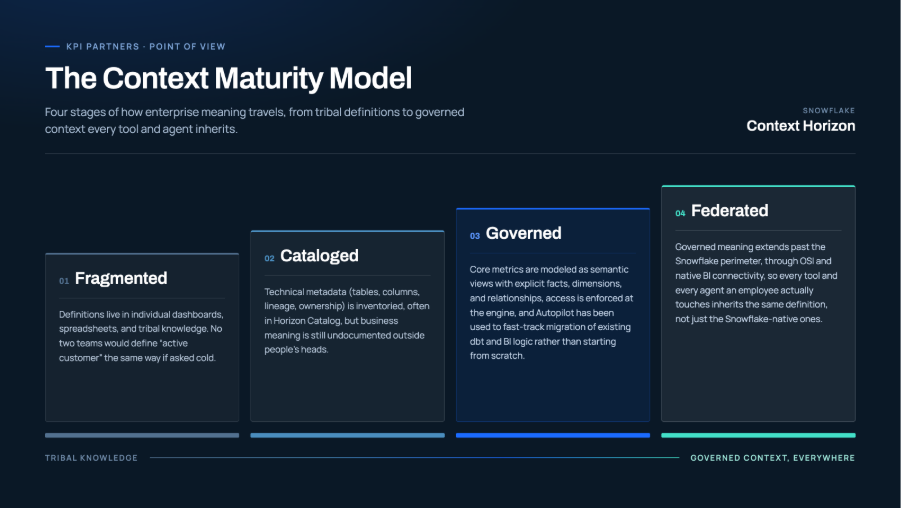
Most enterprises I work with are somewhere between fragmented and cataloged. The jump from cataloged to governed is where the real work sits, and it is organizational before it is technical: agreeing which team owns “revenue,” what the calculation actually is, and who gets to change it.
Where KPI Partners Comes In
The platform capability is one part of the answer. The harder part is organizational: Agreeing what your core metrics mean, governing those definitions so they hold, and getting people and agents to actually use them. That is the work my team focuses on. As a Snowflake partner, KPI Partners helps enterprises define the semantic foundation, design the governance model around it, and drive the adoption that turns a governed definition into a trusted one in daily use. We approach it business first, starting from the metrics your leaders argue about most, and grounding the technical design in those decisions rather than the other way around. This is how we would deliver it; The goal is a foundation your teams and your agents can both rely on.
The Real Decision is Organizational, Not Only Technical
If there is one stance I would leave you with, it is this. The durable advantage in enterprise AI will not come from owning the cleverest model, because models are converging. It will come from the discipline of agreeing what your numbers mean and governing that agreement so consistently that every dashboard, application, and agent inherits it. Horizon Context gives that discipline a natural home inside Snowflake. The companies that treat governed meaning as a strategic asset now, while the capability is still early, are the ones that will trust their agents sooner, and act on their answers with confidence.