Key takeaways:
- One approved meaning for each finance term in its business context. Snowflake Business Ontology gives each finance term, such as net revenue or Days Sales Outstanding (DSO), an owner, an approval status and a link to the metric that calculates it. Where domains use different definitions, those differences remain explicitly labeled rather than being forced into one universal meaning.
- Agents that act on what finance approved. KPI Partners' DomainIQ Agents for Finance, pre-built or custom-built for your use case, discuss, decide and act on those definitions across Accounts Payable (AP), Accounts Receivable (AR) and General Ledger (GL), with human sign-off.
- Built on what you already have, ready for preview day. The ontology links to existing semantic views, glossaries, and Business Intelligence (BI) models. Finance teams can define and approve their terms now, then validate how agents use those definitions when Business Ontology becomes available in public preview.
Treat Business Ontology as Finance's Chart of Accounts for AI
Before finance trusts an AI-generated number, someone must own what that number means. That is why I read Snowflake's new Business Ontology differently from the early conversations that treat it as a catalog feature for data teams: It is the chart of accounts for Artificial Intelligence (AI), and the Chief Financial Officer (CFO) should be the one who signs it.
A chart of accounts works because finance decides what each line means and everyone else posts to it. Business Ontology brings that same discipline to AI agents. Each business term gets one approved definition, a named owner and a link to the metric that calculates it, and only approved definitions are served to agents in Snowflake Cortex Code (CoCo) and Snowflake CoWork. That mirrors exactly how we at KPI Partners approach finance agents on Snowflake: Meaning first, agents second.
Put Finance, Not IT, in Charge of the Definitions
The appetite is already there. Gartner reports that nearly 60% of CFOs plan to raise finance AI investment by 10% or more in 2026, and its 2026 finance AI research finds that accounts payable and receivable automation generally delivers returns within nine to 10 months.
Business Ontology is designed so that domain experts define the concepts and engineers connect them to data. For finance, that split matters, because one word can carry several valid meanings. In Snowflake's own engineering example, Finance defines net revenue as recognized revenue after refunds and discounts, while Sales defines it as bookings net of discounts at signing. Both are approved, both are labeled, and neither overwrites the other.
Here is what that ownership looks like by role:
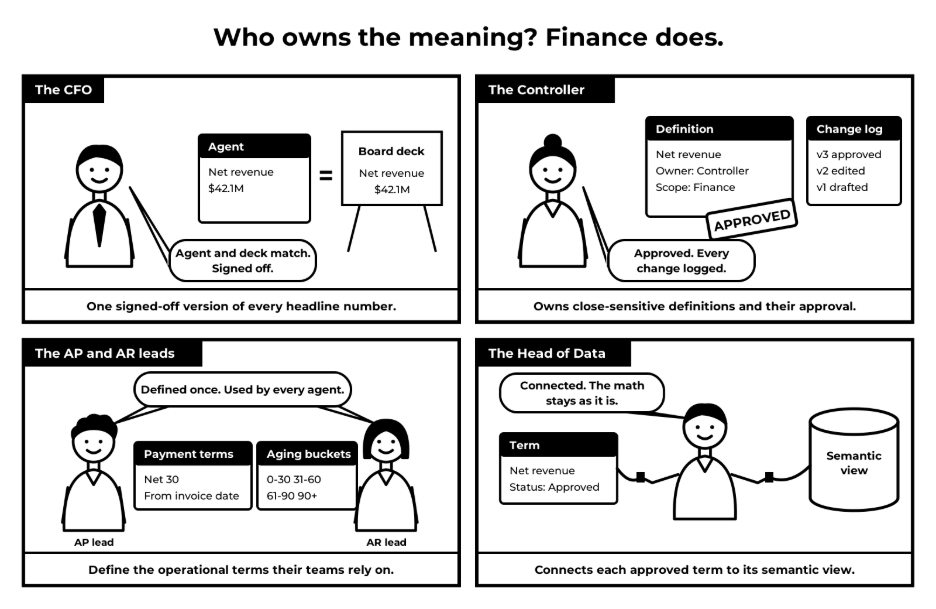
The thread across every role is accountability. When finance owns the meaning, the agent stops freelancing and starts working from the finance policy manual.
Define Your AP, AR and GL Terms Before the First Agent Goes Live
A finance ontology does not need to model the whole business on day one. Three domains give agents the most to work with.
|
General Ledger |
Accounts Receivable |
Accounts Payable |
|
Account hierarchies, entity structures and headline metrics such as net revenue and operating expense. Policy concepts can capture the rules an agent must follow, such as reporting revenue only when it is recognized. |
Customers, invoices, aging buckets and DSO, each with one approved formula and a clear link to collections data. |
Suppliers, invoices, payment terms and Days Payable Outstanding (DPO), defined once so every agent reads a due date the same way. |
The ontology's relationships matter because these domains are connected. An agent asked how cash moved this month needs to see receivables, payables and the ledger as one story, not three tables. Business Ontology gives it that map, signed off by the people who own each part.
Turn Approved Definitions into Agents That Act
An approved definition becomes far more valuable when an agent can act on it. That is where KPI Partners' DomainIQ Agents come in. Every DomainIQ agent follows the same governed loop: It discusses a question in plain language, recommends a decision with the evidence and lineage behind it, and acts across systems once a person approves. For finance, that loop runs on the AP, AR and GL definitions your owners have approved, so the agent reasons from finance's own rulebook.
Finance teams can start with a pre-built DomainIQ agent for common use cases, or have KPI Partners custom-build one for the workflow that matters most to them. Either way, guardrails, role-based access and human-in-the-loop approval are built in, and the agent runs on the Snowflake environment you already operate. We bring this as a Snowflake Premier Tier partner with 40+ Snowflake customers, 40+ certified consultants and CoCo Preferred status.
We Are Ready for Business Ontology on Day One
For a large beverage manufacturer on Snowflake, KPI Partners delivered conversational Business Intelligence for sales and finance users with our AI-driven BI accelerators. We taught the model the business through a data dictionary of company terms, a tailored library of example queries and a self-correcting execution loop, then validated it against 150 business questions the client supplied. The result: 99%+ accurate responses overall, 100% on the validation set, and accuracy rising from 80% on the first version to 100% on the second.
This case demonstrates our experience preparing business context and evaluating conversational BI. The relevance is the preparation discipline: document business terms, test against questions supplied by the business, and validate the answers before relying on them.
Already Building Semantic Views? Link Them, Don't Rebuild Them
Many finance and data teams are already well into a semantic layer, whether in Snowflake Semantic Views, dbt or a BI model in Power BI or Tableau. Business Ontology is built to sit alongside that work, not replace it. Semantic Views keep calculating each metric; The ontology governs what the metric means and who approved it. Existing glossaries can be imported, Cortex Sense can propose a first draft, and metadata connectors bring in definitions from Power BI, Tableau and dbt.
So, if your team has spent the past year building semantic models, that investment becomes the foundation. KPI Partners helps map what you already have into the ontology, settle which finance variants to keep as approved and labeled definitions, and connect each one to the agent that will use it.
Start This Quarter, Before Public Preview Arrives
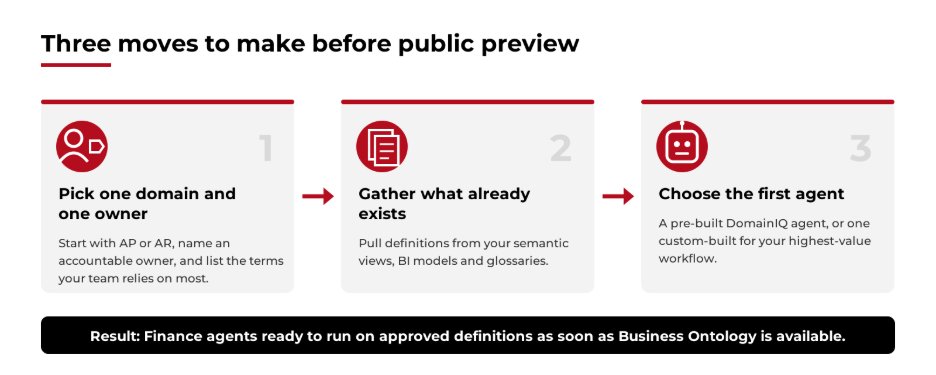
Business Ontology is announced for public preview soon, so this is the moment to prepare rather than to claim results. Here are the three moves I would make now:
Snowflake Governs the Meaning; KPI Partners Helps Finance Put It to Work
Before expanding a finance-agent pilot, I would ask evidence against four questions:
- Does the agent use the approved definition consistently?
- Can a reviewer trace its answer to the underlying data?
- Does it stop for the required human approval?
- Does it reduce the time finance spends checking and reconciling answers?
Agree those evaluation criteria before the pilot begins, rather than treating a convincing demonstration as proof of readiness. Our role is to help finance fill that ontology with the right definitions and put agents to work on them. Together, that is how an agent earns its seat at the month-end close.