Modernizing data engineering often requires migrating Informatica to the Databricks Lakehouse. However, this complex process raises practical questions: how do you ensure efficiency, minimize risk, and achieve the expected ROI?
Success depends on choosing the correct methodology and partner. Generic frameworks often fall short.
The KPI DataBridge Suite includes the Data Platform Migration Accelerator, featuring the Informatica to Databricks Migration Accelerator. This purpose-built, AI-assisted solution accelerates Informatica to Databricks migration and provides a more cost-efficient path to the Databricks Lakehouse.
Learn how KPI Partners Informatica to Databricks Migration Accelerator reduces conversion effort and cost, improves predictability through an assessment-first plan and validation gates, and helps teams transition smoothly.

Why Leading Enterprises Are Moving from Informatica to Databricks
Your reasons for moving are sound. Databricks integrates engineering, analytics, and governance, offering tangible benefits over legacy platforms:
- Mitigate Future Platform Risk: Informatica’s evolving support landscape post-SFDC acquisition adds uncertainty. Moving now ensures long-term stability and innovation.
- Handling Feature Differences: Ensuring functional parity can be complex. Informatica features need careful mapping, and sometimes, Databricks requires different approaches.
- Defining the Right Migration Approach: Informatica’s evolving support landscape post-SFDC acquisition adds uncertainty. Moving now ensures long-term stability and innovation.
- Mitigate Future Platform Risk: It is vital to choose the best strategy. Poor planning increases operational risk, while consistent execution ensures smooth cutovers.
- Managing Training and Change: Teams need training on Databricks. Adapting to new workflows takes time, and effective change management is crucial.
Key Migration Challenges to Address
While the goal is modernization, the Informatica to Databricks migration process itself, particularly when manual, introduces significant hurdles:
- High Migration Cost and Timelines: Manual code conversion extends timelines, and rewriting complex logic drains resources. This significantly impacts the overall project cost.
- Handling Feature Differences: Ensuring functional parity can be complex. Informatica features need careful mapping, and sometimes, Databricks requires different approaches.
- Defining the Right Migration Approach: It is vital to choose the best strategy. Poor planning increases operational risk, while consistent execution ensures smooth cutovers.
- Mitigate Future Platform Risk: It is vital to choose the best strategy. Poor planning increases operational risk, while consistent execution ensures smooth cutovers.
- Managing Training and Change: Teams need training on Databricks. Adapting to new workflows takes time, and effective change management is crucial.
The Solution: KPI Partners' Informatica to Databricks Migration Accelerator
The migration process utilizes AI-assisted automation to accelerate key steps.
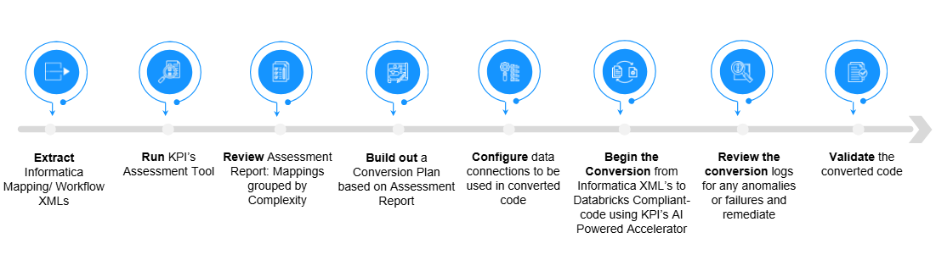

How the Informatica to Databricks Migration Accelerator Works
Engaging with KPI Partners Informatica to Databricks Migration Accelerator experts to support your migration is a straightforward process:
- Request a Demo: Schedule a session with specialists to demonstrate the Informatica to Databricks Migration Accelerator and process.
- Share Sample Mappings: Provide 5–10 representative mapping XML files for an initial proof-of-concept (PoC) conversion if the demonstration meets your needs.
- Initial Conversion: The team analyzes the samples and uses the tool to convert them into corresponding Databricks notebooks.
- Review Session: A follow-up session reviews the converted notebooks, explains the resulting code and logic, discusses the automation benefits observed, and gathers technical feedback.
- Scale Up: Following a successful PoC, collaboration helps plan and execute the accelerated migration for the remaining scope using the tool and methodology.
Key Benefits of the Informatica to Databricks Migration Accelerator
The Data Platform Migration Accelerator and its supporting Informatica to Databricks Migration Accelerator are designed to deliver significant improvements across key areas.
| Benefit | Key Improvement | Potential Business Impact |
| Migration Timeline | Automation reduces overall migration duration | 50-70% reduction vs. manual |
| Code Conversion Cost | Automated conversion lowers manual rewrite effort | 60-80% savings vs. manual |
| Compute Efficiency | Utilizing Databricks auto-scaling and pay-as-you-go pricing | 30–50% lower compute costs |
| Performance Gains | Databricks parallelism improves ETL execution time | 2x–5x faster pipeline runs |
| Development Efficiency | Reusable notebooks, parameterization, version control with Git | 30–40% reduction in dev time |
| Operational Efficiency | Unified monitoring, auto-retries, alerting integrated into pipelines | 25-50% fewer manual interventions |
Ready to Optimize Your Migration?
Ensure your move to Databricks Lakehouse is efficient and cost-effective.
Learn how KPI's Informatica to Databricks Migration Accelerator can improve your migration project today!
FAQs
Is a Big Bang or Phased Approach better?
A phased migration approach is strongly recommended. It minimizes business risk effectively.
Can migration use In-House Resources or External Help?
External help accelerates migration significantly, and KPI Partners’ tools and expertise reduce internal load.
Do ongoing projects need to stop during migration?
No. The migration is typically executed in controlled waves, allowing you to maintain existing service level agreements (SLAs).
Should we use a Manual vs. an Automated Approach?
Automation drastically cuts time, cost, and risk. Manual conversions are slow and error-prone.
How should Training and Change Management be handled?
KPI Partners’ offers Databricks training for teams. Managed services can also support post-migration.